

This is an excerpt from a feature published in the Fall 2026 Issue of 32 Degrees. To access the full issue, click here.
***
By Rick Rauch, Training Manager, Telluride Ski and Snowboard School
Important Project, Looming Deadline
For many ski and ride schools across the country, one of the more anticipated events of a new season is the day new-hire training starts. It’s like the first day of school for the eager new instructors as they gather to begin their journey as a pro skier or rider. For them, just being included is a win. They’ve made it through the interview process, found a place to live, and now have a chance to earn the respect of their students and colleagues.
For schools, it’s the beginning of a process that will shape the next generation of instructors, from naïve hopefuls to professional ambassadors who will carry the mantle of the sports and lifestyles we all love so much. Will they become suitable additions to the core of instructors who represent the resort to a large share of guests?
The process is no small undertaking. Consider that we meet the new teammates in the first few days of December, just a few short weeks before the busiest time of the season. What will they need to know? How will they respond when the holiday crowds arrive and they have lessons on the hill in that busy environment?
Consider your own journey of learning this profession. How much time and effort has been required for you to acquire the knowledge and behaviors necessary to be a comfortable and effective leader of the skiers and riders who come to you for advice and instruction?
The Traditional Approach to New-Hire Training
The traditional approach to new-hire training has been to create a curriculum that includes the basics of snowboard or ski technique appropriate for first-time through green level skiers and riders. This includes familiarization with the terrain that will be utilized, lift use, people skills, the Teaching Model, basic equipment set-up, safety protocols — the list goes on. All that information is then presented to the new instructors in lecture format while they’re standing on the side of the beginner area, in the hope that they will stay engaged and retain the parts and pieces they’ll need to be successful on day one.
At many resorts, after the initial training, new instructors can then shadow an experienced pro during a lesson to see how teaching works in practice. Afterward, they debrief to discuss what the rookie noticed and learned during the day. This marks the start of the new hire’s career as an instructor. At more progressive schools, the new instructor may also teach a lesson while being observed by an experienced pro, creating an opportunity for feedback. We call this a “shine.”
So, off they go into the amazing career of teaching snowsports to an adoring public. If you’ll recall from your own experience, some lessons go beautifully, some not so much. The employing school hopes you’ll get all the bugs worked out in the next three weeks because the holiday season is around the corner, at which time it’s “all-hands-on-deck.”
Clearly, the accepted method for training newly hired instructors has some drawbacks. For the new staff, there is a tremendous amount of information to take in over a very brief period. This can lead to cognitive overload, resulting in diminished retention of information and fatigue nearing burn out, even after the first week. Given the short turnaround between the initial training period and the arrival of the holiday guests, confidence is often lacking. The resort told them to “do it this way” and the absence of alternatives when a lesson doesn’t go as planned can be frustrating. Having been sequestered in their new-hire groups for the first week also prevents new instructors from feeling like they’re a part of the team.
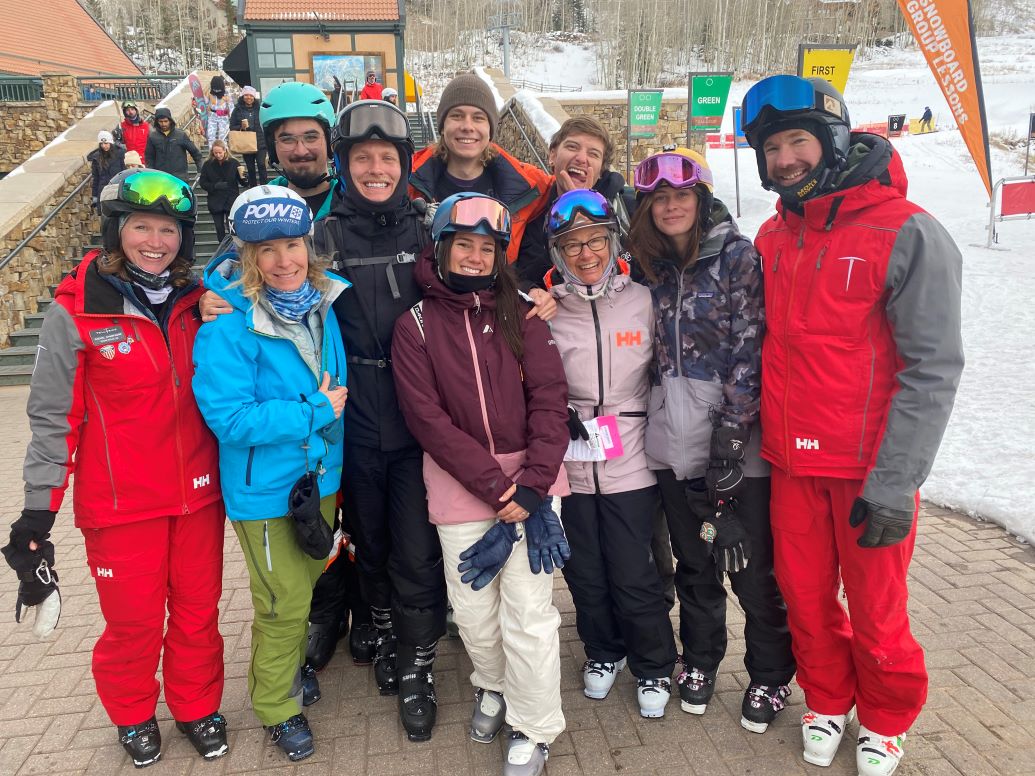
Many ski and snowboard schools face some challenges under the status quo. How ready will the new staff be when the holiday business hits? How do they manage all the questions left unanswered in training? How do they use sub-standard, early performance issues as learning opportunities? Are they getting good return on investment from the time and money committed to training?
Despite these drawbacks, the standard, linear, didactic approach continues to be the mainstay of new-hire training. And why not? A few years ago, while working at Winter Park Resort, Kim Peterson, PhD, Educational Leadership and Innovation, a Level 3 alpine and Level 1 adaptive instructor, with a Children’s Specialist 2 credential, and author of the “Guest-Centered Teaching Model,” described the arc of an instructor’s development in three stages: Copy, Choose, Create.
Early in their career, new instructors often Copy. They will use an example they’ve seen or heard and apply it in the lessons they teach. After some experience, instructors will enter the second stage, Choose. Pros will select from a short list of approaches they’ve seen that may best fit the lesson circumstances and students they’re currently working with. The last stage is Create. Well-seasoned, confident instructors will customize or innovate teaching content, in the moment, from their own knowledge base.
The traditional approach for new-hire training fits the description of the Copy stage. “We’ll show you what to do and how to do it. You’ll then go out and do what you’ve been shown.” Unfortunately, many schools have allowed this condition to limit their creativity for improving the new-hire training experience.
Given the short time frame between new-hire training and the holiday rush, the possibility of accelerating that skill development, from Copy to Choose to Create, became a driver of change in the Telluride Ski and Snowboard School.
Re-Imagining New-Hire Training
For the 2023-2024 season the Telluride Ski and Snowboard School decided to re-imagine the usual scenario by electing to have the new instructors train themselves. Our objective was not simply to help new instructors remember information. We wanted to accelerate their development from copying established teaching patterns to making sound decisions independently when lessons unfolded in unexpected ways. The reaction was immediate and skeptical as the new-hire training team scanned the clinic description they’d just been handed. It described a training approach in which the usual, linear method was abandoned in favor of an approach borrowing techniques from experiential learning, ecological dynamics, and constraints-based learning. Ecological dynamics, the study of how organisms move in their environment, and constraints-based Learning (Newell, 1986) lean on the natural process of motor skill development based on how organisms (people) move related to their perception of their environment. Both theories rely heavily on the idea of the learner doing as a major component of the skill acquisition process. We were counting on these principles working with learning at this level as well.
***
Read the rest of the feature here. And then watch the First Chair Podcast episode, “A Case Study on New-Hire Training,” during which Rauch expounds on rethinking new-hire training.