

By Angelo Ross, Eastern Alpine and Children’s Examiner
“I like to follow [my students] and copy their movements to understand what they are doing.”
I recently read the quote above – a comment on a PSIA-AASI social media post – and was struck by how concisely it describes an instructional strategy called mirroring. Mirroring is described as copying someone with the intention of understanding them, and it is a best practice in teaching and learning.
Fundamental Learning Capacities
Likely, our capacity to learn by copying others is an evolutionary survival strategy. A foundational capability, motor resonance – the ability to match what is observed – evolved 100+ million years ago. Many vertebrates have this capacity. Dogs synchronize speed, turning, stopping, and changes in pace while walking in a pack; young songbirds learn to sing by listening to their parents.
Among primates, observational learning gained sophistication tens of millions of years ago and includes behaviors like termite fishing in chimpanzees and chasing games and social greetings in bonobos. Intentional teaching likely evolved within our genus, Homo, as suggested by production of stone tools too complex to be copied through observation only. Purposeful demonstration and guided practice – teaching – was likely required for learning those skills.
Familiar learning theories, like Albert Bandura’s Social Learning Theory, are compatible with evolutionary theories from multiple fields and can be viewed as modern human psychological capacities grounded in ancient evolutionary mechanisms.
Learning in Levi
At Interski 2023 in Levi, Finland, I was fortunate to attend two sessions about brain-based learning with the Czech Republic National Team. Brain-based learning is an educational approach that aligns instructional methodologies with evidence from neuroscience about how the brain receives, processes, and retains information.
During the on-snow session, a large group of us – about 40 people – was instructed to form a circle and to identify our partner-to-be through eye contact alone – no talking. Awkward silence with uncomfortable, darting eyes ensued, but, within a minute, each of us had locked eyes with someone else; signaled acknowledgment of the connection through subtle, non-verbal cues; and slid together for introductions. Partnerships formed.
My partner was Angela Cesnik from the Australian National Team (APSI). After a very brief sharing of names – and a chuckle because ours are essentially the same – we were instructed to stand face-to-face about two feet apart and, again without talking, decide who would lead the unknown upcoming activity, and who would follow. Without words, we somehow determined Angela would lead.
Leaders were instructed to spend 60 seconds going through the motions of their morning bathroom routine while followers were to reproduce their movements exactly, like reflections in our partner’s mirror. This meant we had to coordinate opposite limbs and directions – if Angela “brushed her teeth” with her right hand, I needed to use my left. If she turned to face her left, I had to turn to my right.
It was comical to say the least – and insightful – 40 strangers emulating each others’ private bathroom affairs: eliminating morning breath, applying deodorant, and wiping away goobers in the corner of your eye. We giggled as we privately determined how personal we would let this get – and we connected. After one round, we switched and the other partner led.
Angela and I had never met and, almost literally, live in locations exactly opposite each other on Planet Earth. However, within a minute, we selected each other as partners, determined who would lead and who would follow, and gained superficial insights into some personal details about each other, all through eye contact and copying each other. I loathe icebreakers, but this was already a pretty cool clinic.
For the next step in the process we were instructed to ski, only now we would face the same direction: tandem mirroring versus reflective mirroring. The original leader was told to make predictable medium radius turns with the follower closely behind, positioning their limbs, poles, helmet, skis – all the parts – in space to copy the leader exactly.
At a predetermined stopping point, the follower described how mirroring the leader altered their technical performance. The follower then became the leader for the remainder of the run. During the lift ride, Angela and I further discussed similarities and differences in our techniques, impacts on our performance, APSI and PSIA-AASI values, a bit of global politics, and continued learning from one another. It was a high-impact experience in a short amount of time. In the corresponding afternoon indoor session, Czech researchers walked us through the brain-based science behind their work, explaining why the on-snow session was so impactful. Mirroring is demonstrated to facilitate trust, empathy, and understanding.
Back in the States
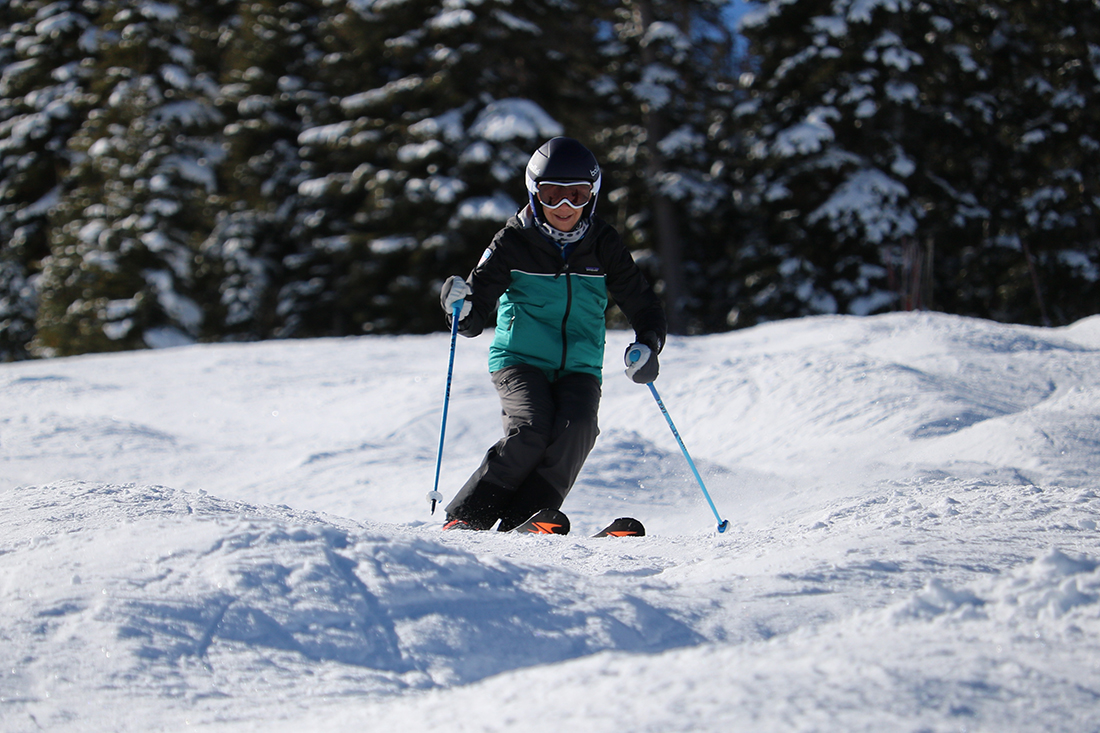
Skiing with Ellen Post Foster is a treat. Her impact on American skiing generally, and our association specifically, cannot be overstated. She is the 1973 Junior National Champion of Exhibition Skiing; aerials, ballet, moguls, and combined champion in international freestyle competition in 1975; alumna of the 1980 and 1984 PSIA National Demonstration Teams; Class of 2016 U.S. Ski & Snowboard Hall of Famer, 2021 Colorado Snowsports Museum Hall of Famer; and a prolific snowsports author.
Often, while skiing with Ellen, she will disappear. She’s small, rigged for silent running, and has exceedingly nimble touch. I don’t think she’s ever damaged a snowflake in her life. One of the first times I skied with her, I could see her in my periphery and then I couldn’t. When she reappeared at the lift, I told her I thought we had gotten separated. She informed me she had been behind me, following so she could understand my skiing. She then asked my permission to tell me what she had observed and to give me some feedback to improve my performance (which I immediately accepted and still endeavor to integrate.)
As co-author of our current Teaching Snowsports Manual, Ellen understands the value of mirroring for teachers to understand their students. Following students is mentioned several times in that manual as a teaching skill.
Mirroring in Practice
Since Interski Levi, I have successfully incorporated mirroring into my strategies for creating impactful learning environments. Last November at Rocky Mountain Telemark Education Staff Training, I used a similar format to what the Czechs had done in Levi, with an indoor session meant to facilitate connection between paired partners leading to an outdoor session requiring careful observation and honest feedback between partners.
In December, I used a modified on-snow version with a group of National Ski Patrol leaders at the Outdoor Emergency Transportation Conference at Killington, Vermont, to facilitate partner observation and subsequent discussion of how various movement patterns can have applicability in different circumstances. Feedback from both sessions was positive and included comments about connecting quickly, developing trust, and deep learning.
I encourage exploring mirroring as a teaching and learning strategy through research, practice, reflection, and refinement. Information is easily found online.
Mirroring students provides insights into their understanding and performance of the sport. Having them mirror you encourages communication, facilitates trust, and increases their understanding and skill development. Mirroring peers in synchronized skiing and riding activities is fun, can provide insights into the value of varied movement patterns, and increase technical understanding of the sport by sharpening the eye and providing evidence against the one-right-way mentality that still seems to permeate our association.
Adding this nuance to common Follow Me activities can increase student interest in the activity, enhance learning, and build group camaraderie as students take turns leading and mirroring. This can very easily develop into games, explorations of movement patterns, and experiments – best practices in teaching and learning and PSIA-AASI fundamentals.
Time-tested, research-backed, and part of the fabric of our species, mirroring helps us and our students evolve our understanding, performance, and teaching of snowsports.