

By Leslie Surprenant, Alpine Level II, Children’s Specialist 1, Hunter Mountain
This article appeared in the Spring 2026 issue of the SnowPro, the official publication of the Professional Ski Instructors of America Eastern/Education Foundation.
A piercing shot of wind swirled the snow as our chair crested the Otis Quad’s unloading ramp at New York’s Hunter Mountain. My jacket thermometer registered -5°F. Biting wind made it feel like -30°F. Our skis squeaked on the cold, dry snow as we glided down the ramp to a stop near Ralph Perlberger and three other hardy souls. Most guests were sheltering in the lodge, some jockeying for a spot near the fireplace. Ralph was not among them. Proud of Ralph and his grit, I introduced him to the women from the weekly women’s clinic I was coaching.
It was Ralph’s 95th birthday and, true to his philosophy of skiing in every snow condition and weather, he and his wife, Carol, and two ski instructor friends, David Raindorf and Steve Cohen, were readying for their run. “When I grow up, I want to be Ralph,” David once told me. “Ralph is my idol,” added Steve.
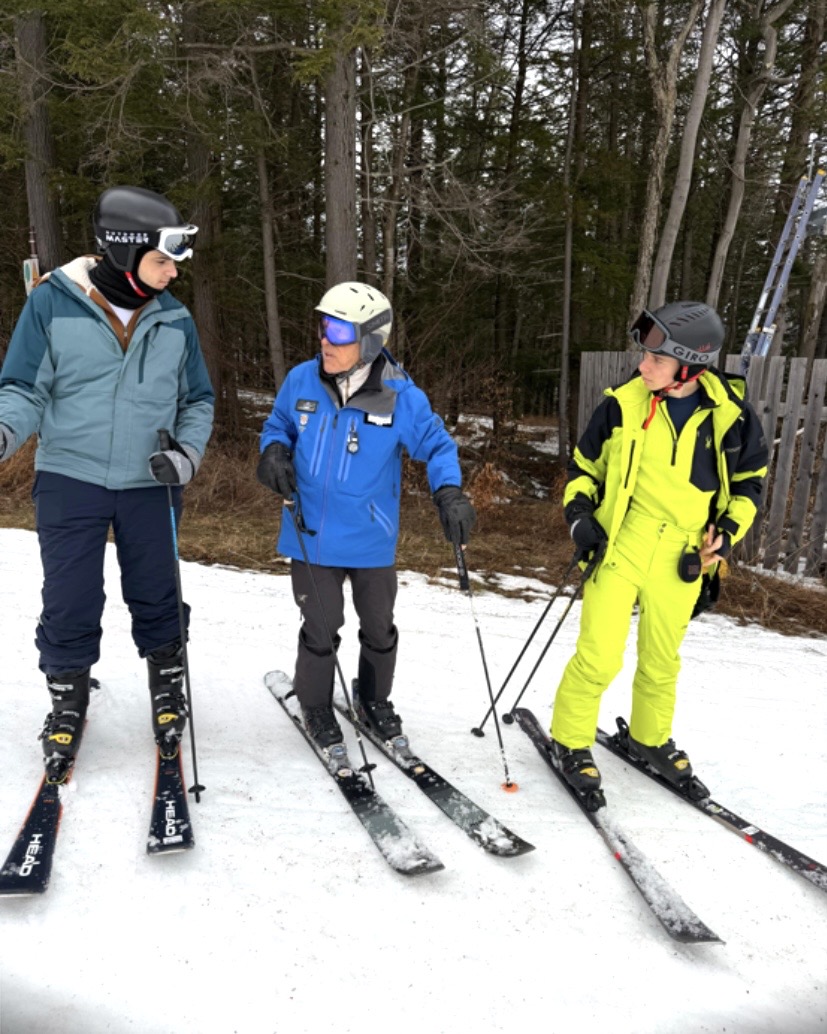
I announced that it was his birthday, and Ralph grinned as we sang “Happy Birthday,” our voices muffled by frozen face masks. He thanked us, then led the way down West Side Glide, an intermediate trail winding among pines and hemlocks. “Ralph is an inspiration,” said Victoria Mercado, the senior manager of Hunter Mountain’s Ski and Ride School. “He’s not only skiing, but teaching! Skiing and riding keep you young. When I watch Ralph ski, I can’t believe he’s 95. His energy, skill, and passion on the mountain defy his age. It’s an absolute pleasure to work alongside him.”
Hope Prevails over Despair
In 1940, when Ralph and his family were living in Amsterdam, Ralph’s father left for New York City to arrange for his family’s immigration, arriving on May 10, the day Nazi forces invaded the Netherlands. The following year, 9-year-old Ralph, his mother, and two older brothers were taken from their home in Amsterdam and imprisoned in Westerbork transit camp in the Netherlands, then transferred by railroad cattle car to the Bergen-Belsen concentration camp in Germany in February 1944.
Despite suffering through typhus and typhoid fever, Ralph was certain he and his family would survive. He credits his parents for his confidence, security, and hope. Early on, he even thought he’d have quite a story to share with friends, once the war ended.
During those years, Ralph’s father didn’t know if his family had survived. However, at war’s end, he learned they were in the Russian-occupied village of Tröbitz, Germany, having arrived there on the “Lost Transport” train, one of three trains on which the Nazis sent 7,500 Jewish prisoners intended to be exchanged for German prisoners.
The “Lost Transport” traveled for two weeks, stopping and rerouting due to destroyed tracks, never reaching its destination. It finally stopped on a destroyed bridge over the Elster River, just outside Tröbitz. Russian troops liberated the train’s prisoners on April 23, 1945. Hundreds had died of typhus and hunger enroute. During the five months the family’s visa applications were pending, Ralph’s father sent them Red Cross packages of food and hygiene products.
After Ralph, his two brothers, and his mother immigrated to the United States in February 1946, the family made its home in New York City. Ralph learned to speak English and excelled in school while his father got to know his family again.
“Keep at It and Don’t Give Up”
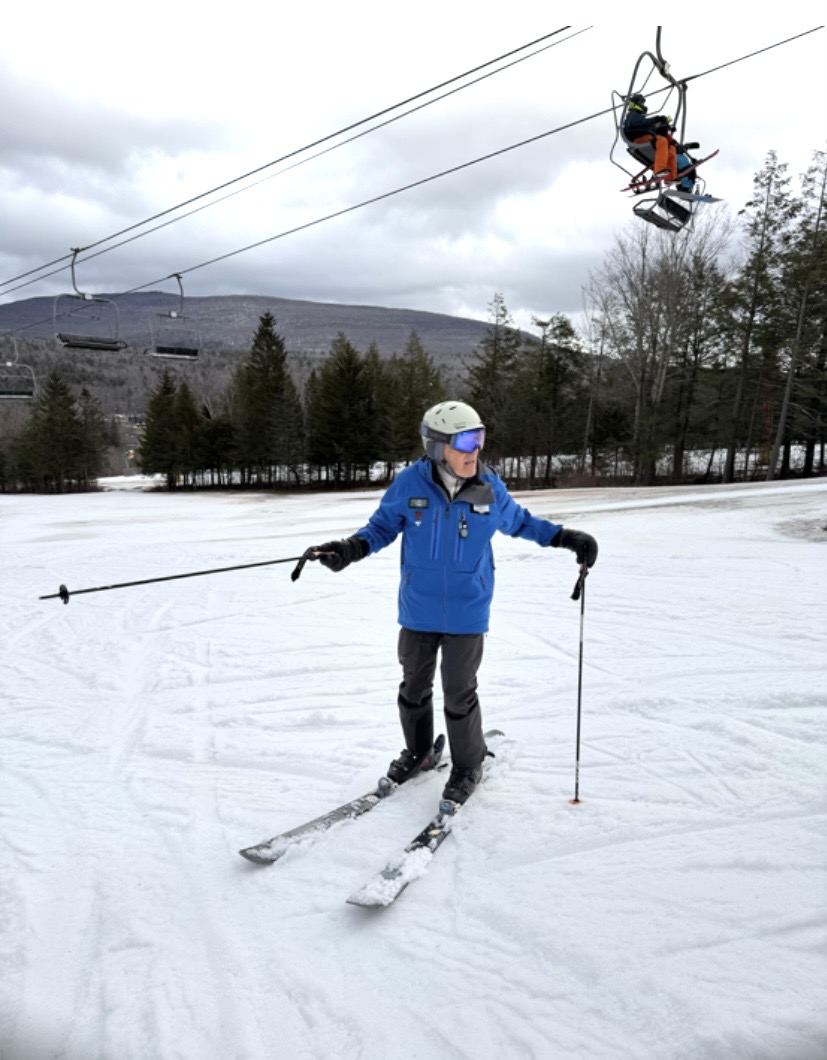
Ralph’s love of skiing began when he was studying economics at Stanford. His father sent him and his two older brothers to Sun Valley, Idaho, during winter break. He was hooked, skiing at every opportunity, even while earning his law degree at Harvard.
After decades of skiing and lessons in Taos, Europe, and at Hunter Mountain, an advertisement caught Ralph’s eye in 2002: For $85, he could ski at Hunter for a weekend of instructor training and candidate selection. If selected as an instructor candidate, another weekend of training and final selection was free. He was among those chosen to become instructors, yet he realized he had much to learn.
Now a PSIA Level II alpine instructor, he insists the best advice he received came from fellow ski instructor and PSIA alpine examiner Charlie Knopp: “Lift your inside hip!”
Beloved by Hunter’s ski and ride school community, Ralph’s colleagues express awe and appreciation for what he means to them. “Ralph has a special place in my heart,” said Eastern Alpine Development Team member Luca Arrigoni. “I shadowed him as a new instructor and was inspired by his patient, gentle, and knowledgeable way with beginners. He still proudly wears the Hunter uniform, which shows his love for, and dedication to, the sport and teaching.”
Ralph especially loves helping adult intermediates. He asks students to describe how they make their skis turn. “I don’t know,” most respond. “I just turn.” Ralph observes that many of these skiers turn using leg rotation on flat skis. He believes many intermediates lack the fundamentals of maintaining center of mass (CM) over base of support (stance), directing pressure to their outside skis, and controlling edge angles. He coaches skiers to feel their shins against the tongue of their boots during all turn phases.
When skiers lean back, he asks them to stop and notice how their quads feel. Most say, “tired” or “burning.” He directs them to notice where their bodies are in relation to their feet, reminding them to keep shin contact with the front of their boots. In the end, Ralph says every student improves, has fun, and thanks him.
Hunter’s ski instructors’ ages span eight decades. Ralph’s advice to the youngest instructors? “Keep at it and don’t give up!” he said. “Don’t let anything stop you. Ski in all conditions and all weather.”
Having recently completed his 24th season of instructing, he has no plans to stop doing what he loves. “Maybe someone above is watching over me,” he said, adding that he’s always drawn inspiration from Baseball Hall of Famer Satchel Paige, who said, “Don’t look back; something might be gaining on you.” For Hunter skiers, that “something” might be Ralph Perlberger.