

By Dave Schuiling, PSIA-AASI Director of Education & Credentialing
The fundamental skills of great snowsports instruction have not changed. What has changed is our ability to align education, professional development, and credentialing around those skills.
Over the past several years, PSIA-AASI has made significant progress toward national strategic alignment. Common standards, unified assessment tools, nationally aligned resources, and shared professional development opportunities have created a more consistent experience for members across the country. While the system continues to evolve, one principle remains unchanged: Certification should recognize and validate the skills that great instructors demonstrate every day.
The Foundation of Great Instruction: The Learning Connection
The Learning ConnectionSM continues to define those skills through three interconnected areas: People Skills, Teaching Skills, and Technical Skills. These are not simply categories on an assessment form. They are the professional competencies that create meaningful learning experiences for guests and colleagues alike. They define what great instruction looks like and provide the foundation for education, professional development, and credentialing throughout PSIA-AASI.
At its best, an assessment is not a performance staged for an examiner. It is an opportunity to demonstrate authentic teaching, coaching, and technical application in a real-world environment. The goal is not to see whether candidates can perform a rehearsed progression or memorize a specific approach. The goal is to understand how effectively they build relationships, facilitate learning, and apply technical understanding to meet the needs of their students.
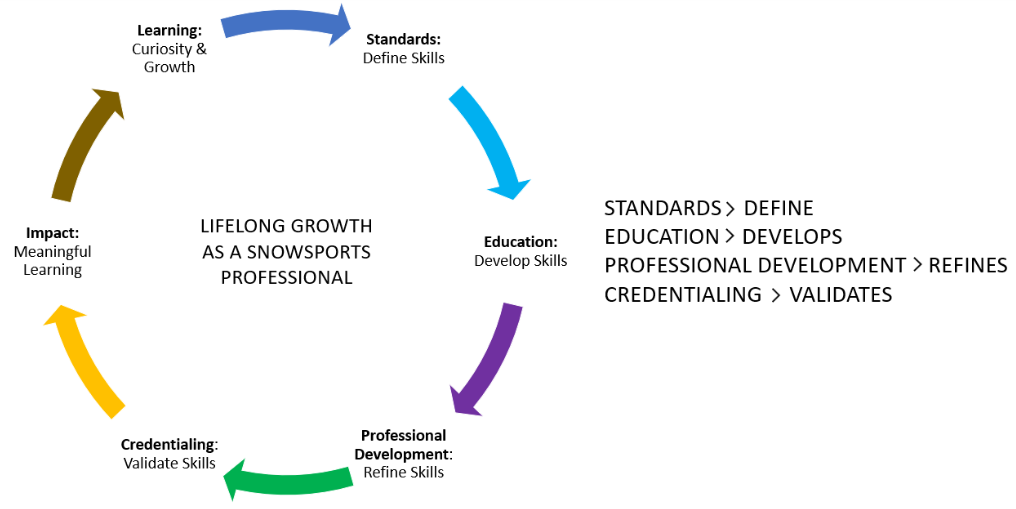
In other words, the assessment should capture what professional snowsports instructors do every day. This philosophy is what connects every part of the system. The standards define the skills. Education introduces and develops those skills. Professional development strengthens and refines them. Credentialing validates them. Each component serves a distinct purpose, but together they create a pathway that supports lifelong growth as a snowsports professional.
The Pathway Starts with Learning
The journey often begins with learning. A clinic, e-learning course, training session, mentor, or teaching experience introduces a new idea or perspective. Learning sparks curiosity. Curiosity leads instructors to ask questions, seek understanding, and explore possibilities. As understanding grows, curiosity often develops into passion.
Passion fuels development. Instructors begin seeking opportunities to improve their skiing, riding, teaching, movement analysis, communication, and leadership skills. They become more intentional about their growth. They seek feedback. They reflect on their experiences. They challenge themselves to learn more and become more effective.
Over time, development becomes professional development.
Professional development is not simply collecting continuing education credits or preparing for an assessment. It is the deliberate pursuit of growth. It is the commitment to becoming more capable, more adaptable, and more effective in creating meaningful experiences for guests. It is the recognition that expertise is not a destination but an ongoing process.
Credentialing plays an important role within that process, but it is not the process itself.
A certification assessment captures a moment in time. It validates the knowledge, skills, and behaviors that have been developed through experience, education, and professional growth. A credential acknowledges that an instructor can consistently demonstrate the standards associated with a particular level of professional practice.
The credential is not the goal. The goal is becoming the kind of instructor who earns it.
When viewed through this lens, assessments become less about proving something and more about demonstrating something. They provide an opportunity to showcase the skills that have already been developed through daily practice with guests and colleagues. The most effective preparation for certification is often the work itself: creating exceptional learning experiences, building relationships, solving problems, and continually refining professional skills.
The People Skills fundamentals provide a useful example. Developing relationships based on trust, engaging in meaningful two-way communication, understanding and managing emotions and actions, and recognizing the motivations and emotions of others all contribute to one overarching outcome: trust.
Trust Is the Cornerstone of Learning
When learners trust their instructor, they become more willing to experiment, take risks, ask questions, and embrace challenges. They become more open to feedback and more engaged in the learning process. Trust creates the conditions that allow learning to thrive.
Once trust is established, Teaching Skills help create an environment where growth can occur. Great instructors collaborate with learners, establish meaningful goals, adapt to changing needs, manage information and experiences effectively, encourage exploration and discovery, and facilitate reflection. They understand that learning is not something delivered to a student. It is something created with a student.
Technical Skills complete the equation by providing the understanding and performance necessary to accurately assess needs, communicate concepts, and guide development. Technical expertise gives instructors the tools to support learning with confidence, accuracy, and purpose.
Together, People Skills, Teaching Skills, and Technical Skills create impact. Impact is ultimately what matters most.
Most of us can identify a teacher, coach, mentor, or instructor who influenced our lives in a meaningful way. We remember how they made us feel. We remember how they helped us succeed. We remember the confidence they inspired and the possibilities they helped us see.
As snowsports instructors, we have the opportunity to create those experiences every day. Guests do not return because they received a perfectly delivered progression. They return because they felt understood. They experienced success. They developed confidence. They built a connection with the mountain, the sport, and the people around them. They return because the experience mattered.
That is the true purpose of our education and credentialing system.
The Reason Behind Strategic Alignment
Strategic alignment was never about creating identical assessments or standardizing paperwork. It was about creating a shared understanding of what great instruction looks like. The standards define that vision. Education develops it. Professional development strengthens it. Assessments validate it.
The progression is both simple and powerful: Learning sparks curiosity, curiosity develops into passion, passion drives purposeful growth, growth becomes professional development, and professional development prepares instructors to earn credentials that recognize their ability to create trust, inspire learning, and make a lasting impact.
Together, these elements create a credentialing system that reflects the real work of professional snowsports instructors and increases the value of PSIA-AASI credentials for members, snowsports schools, and the guests we serve.
Because in the end, certification is not about passing an assessment. It is about developing the knowledge, skills, and behaviors that help people learn, grow, and return to the mountain for more.