

By J. Scott McGee and Jacob Crawford
This is an excerpt from an article published in the Fall 2025 Issue of 32 Degrees. Access the full issue here.
Do you ever feel like you have a veritable cornucopia of drills, games, and activities but aren’t sure which one(s) will help the students in front of you the most? Do you ever know exactly what you want your students to change in their skiing, but you’re not sure which activities will help make it happen? Do you ever feel like there’s so much you want to change in your students’ skiing that it’s hard to know how or where to start? We’ve definitely experienced those feelings, both on the hill in front of guests and in exam situations.
We want to share our take on a strategy from the Teaching Snowsports Manual that can help develop a structure for movement analysis (MA) and for introducing new movement patterns to our students. The manual (see page 51) describes this strategy as a four-phase process – Static, Simple, Complex, and Applied – abbreviated SSCA, for introducing new movements.
The static phase introduces a movement without sliding, allowing students to focus on sensation and movement without the distraction of balancing forces from motion. The simple phase takes the movement introduced in the static phase into a traverse, straight run, or single turn to gain comfort with the new movement while sliding on snow without the added complexity of linking turns. The complex phase is where the new movement is brought into linked turns to practice and gain ownership of it. Finally, the applied phase is where the learning experience is brought full circle back into the students’ “normal” skiing by guiding practice in terrain that reinforces the learning in the previous phases.
A DYNAMIC WAY TO VIEW THE FOUR PHASES
The linear progression described above is in and of itself a powerful tool for teaching new movements to students, but we propose a more dynamic way of viewing the four phases, both as lenses through which to structure movement analysis and as building blocks that can be ordered differently to tailor teaching specifically to the students in front of us.
When we do MA, we are basically looking at our students performing an applied phase activity; they’re likely executing the turns they want to improve in the terrain they want to ski better. These could be basic parallel, carving, or bump turns. We recommend conducting MA in this setting, as it makes it far easier to ensure that what we choose to address aligns with their goals.
When we make our initial observations through the lens of an applied phase in teaching, it can help us orient our attention to the movements, which, if made more effective or efficient, will have the greatest impact on our students’ goals. As an added bonus, the last activity of the day could be used to highlight the progress students made by repeating the same turns! Conducting movement analysis through the lens of the applied phase helps us begin to home in on which movements will have the greatest impact on student goals. However, even the short list we might derive through the applied lens has too many movements to address in one lesson. So, we need a lens with higher resolution.
Here we propose using the static phase as a lens to identify specific cause-and-effect relationships between single body movements and ski performance outcomes. Static activities isolate cause and effect. Ask yourself: “Can I replicate this movement while standing still?” If it can’t be replicated, it likely hasn’t been reduced to a single cause-and-effect relationship.
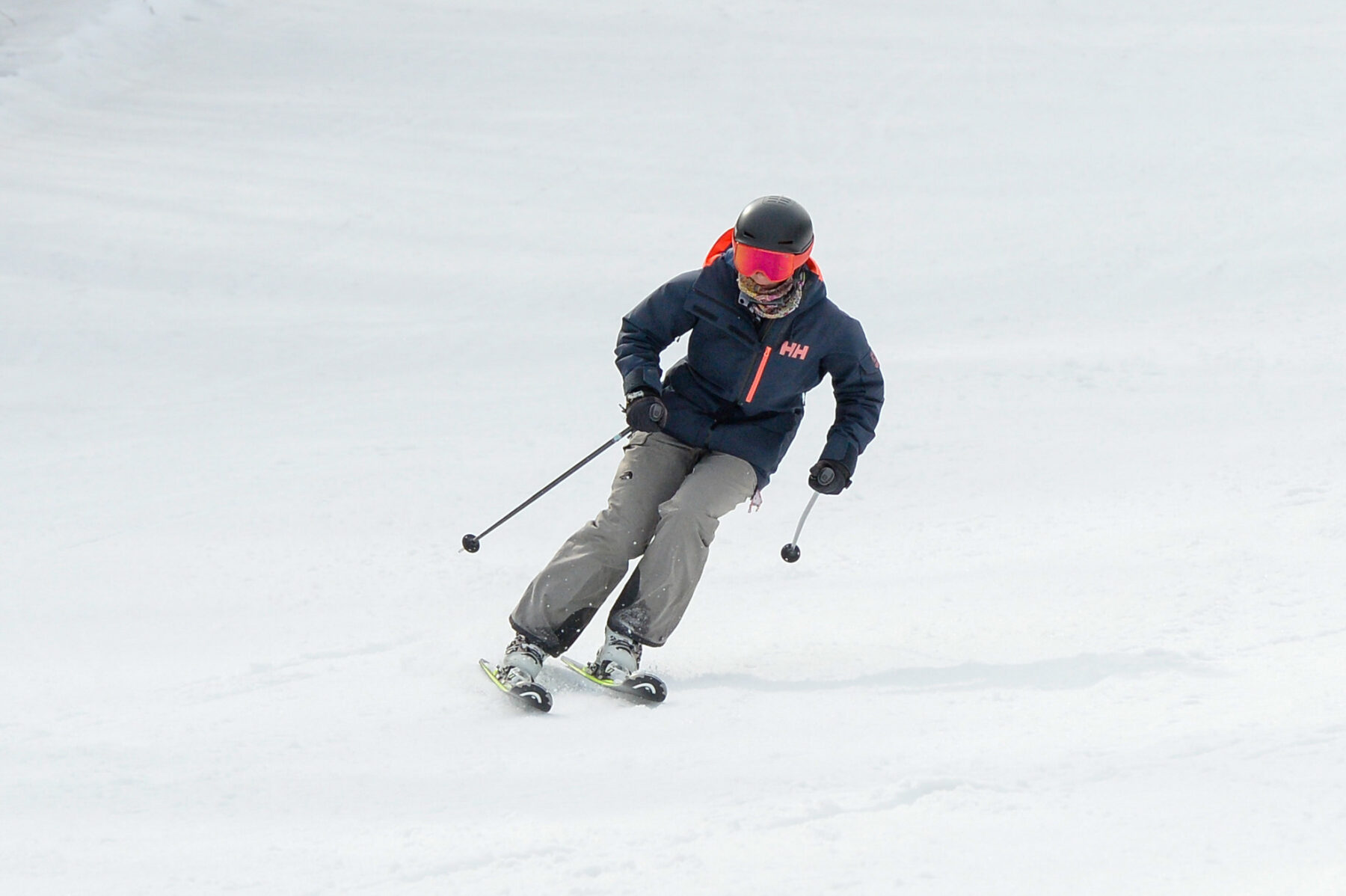
For example, in the photo above, it can be seen that Heather is achieving different edge angles on her inside and outside skis and her legs are not tipped the same amount. As shown in the featured image at the top of the page, the cause-and-effect relationship between tipping the legs and the edge angles of the skis can be replicated in the static phase by standing still and using the hands to tip the knees. Granted, we move through positions that are untenable statically, so it’s fine if we need to either reduce the magnitude of the movement or use a prop or a friend to make the movements while standing still. However, that doesn’t change the fact that we should be able to replicate our observations with one movement while standing still.
We have now used both the applied and static phases as lenses to determine the movement we want to change. But how do we go about making the change? This is where the complex phase comes in. You can use your bag of tricks here by pulling out a drill such as railroad track arcs that emphasize the fundamental(s) or movement pattern in a turning context. Once you choose a complex-phase drill, the simple phase becomes the bridge, reducing the complex activity to a single turn, traverse, or straight run to clearly connect it to the new movement.
***
Read the rest of the article here. And then watch the First Chair Podcast episode, “Build Better Lessons: A Smarter Way to Create Progressions,” during which McGee and Crawford delve into introducing new movement patterns for their students through a four-phase – Static, Simple, Complex, Applied (SSCA) – process.