

By Christian Green, Executive Editor
On April 11, adaptive sports advocate and innovator Doug Pringle will be inducted into the U.S. Ski & Snowboard Hall of Fame, one of eight members of the Class of 2025.
As a member of the Move United Adaptive Sports Hall of Fame, PSIA-AASI Lifetime Achievement Award recipient, and Western Region lifetime member, one might think that Pringle’s devotion to snowsports developed at a young age. However, as the 82-year-old Pringle recently recounted, he had no interest in skiing, especially after his initial experience on snow.
While a cadet at the United States Military Academy in the mid-1960s, he attempted to ski for the first time. The experience was forgettable. “It was one of those situations where a couple of my friends took me out to a little ski area on campus,” he remembered. “I put skis on my feet, went up a rope tow, and proceeded to crawl down the hill.”
An Unexpected Turn
After graduating from West Point, Lieutenant Pringle was deployed to Vietnam in spring 1968. During a mission, he was hit by a rocket-propelled grenade (RPG) and had to have his right leg amputated just below the knee.
While rehabilitating at Letterman Army Hospital in San Francisco, his life changed thanks in part to Jim Winthers, a World War II veteran who had been a member of the elite U.S. 10th Mountain Division. As Pringle recalled, in the winter of 1968-69, Winthers showed him and other veterans in his ward a home movie of a guy skiing on one leg at Donner Summit. At the conclusion of the movie, Winthers simply said, “I want to teach all you guys how to ski on one leg.”
Given his unremarkable debut on the hill at West Point, Pringle stayed behind during that first trip. But it didn’t take him long to realize that it could be beneficial to get out of the hospital for a couple days. So, he joined Winthers and his wardmates the next time they went out.
After struggling on snow the first day, he put together three turns without falling on the second day. That was enough for Winthers. He presented Pringle with a patch, told him he was a skier, and that he would have to start out as an apprentice instructor – shoveling snow and pulling out equipment – if he wanted to continue to ski for free.
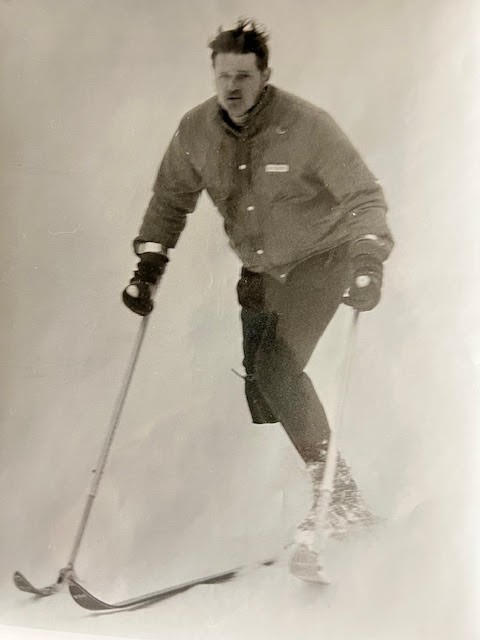
He may not have known it at the time, but Pringle had just started a journey that would take him around the country – as a leader of several organizations – in the years to come. And it all began on Donner Summit.
“The organization, which now has over 245 chapters worldwide, had one chapter called National Amputee Skiers Association (NASA),” Pringle said of the group that got its start at Donner Ski Ranch; was renamed the National Handicapped Sports and Recreation Association (NHSRA) in 1976; then Disabled Sports USA (DSUSA) in 1994; and rebranded as Move United in 2020. (All told, the organization he became part of in the late 1960s has been through eight name changes and that inaugural chapter is now called Achieve Tahoe.)
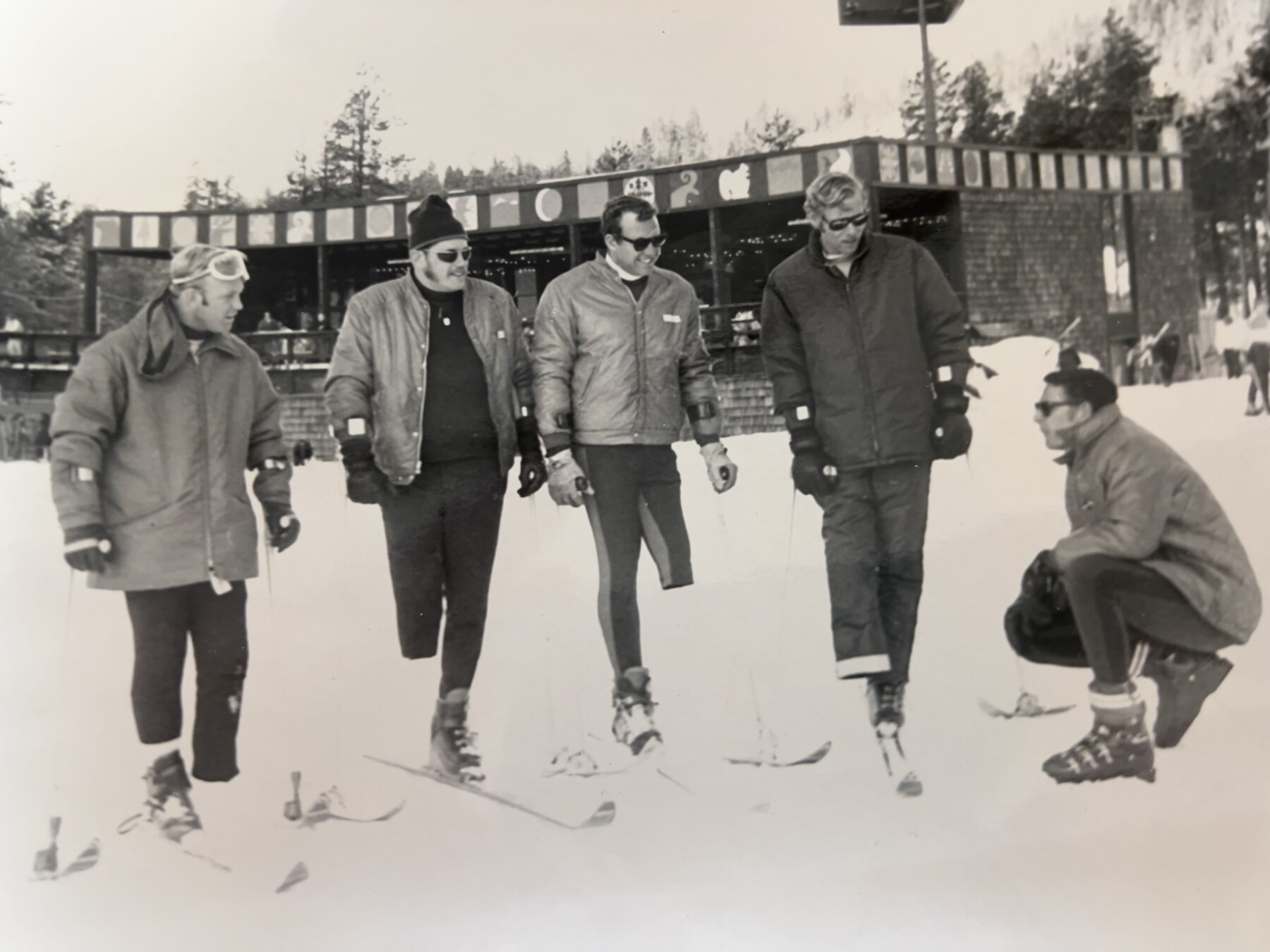
During those early years, Pringle said that Winthers taught him how to be an instructor, but more importantly, how to shift the focus to those he was teaching. “Instead of worrying about ourselves and our problems, we worried about the next guy who came up,” Pringle said. “We had a different uniform, a different mission, a different belonging. And so it changed our lives, and it became my life’s work.”
A Calling Focused on Equal Opportunity
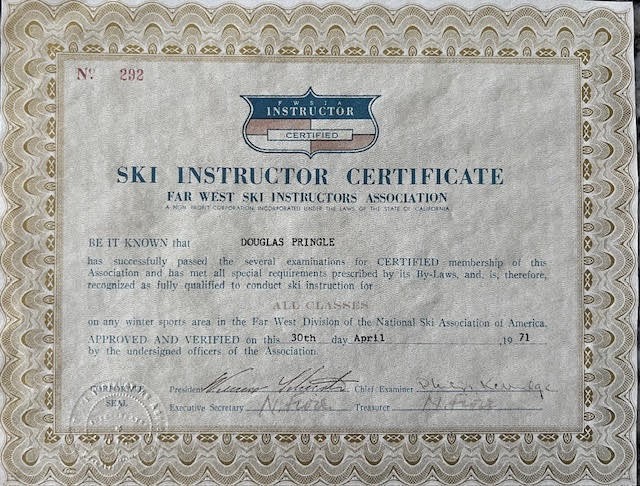
Over the next few years, Pringle became one of the first amputees to become a fully certified instructor, he won three national slalom championships, and he was named president of NASA, turning his attention to teaching and helping to certify people with disabilities by establishing 25 NASA chapters by 1976.
He was initially met with some resistance regarding his ability to teach people to ski. Some believed that he might not have the capability to demonstrate every technique. Undeterred, he maintained that although he may have “one less tool in his tool bag,” what mattered most was his ability to impart skills to his students.
According to Pringle, soon after he “somehow got himself onto the PSIA-AASI board of directors to represent adaptive skiing” and then set out, with help from Western Region examiner Ted Pitcher, to develop an exam for adaptive instructors. The result: the first national adaptive skiing exam at Jackson Hole, Wyoming, in 1984.
“I went around the country to the five or six people who I knew had a great deal of experience teaching adaptive skiing,” Pringle said of recruiting the likes of Gwen Allard, Davin Bremner, and Katherine Hayes Rodriguez, who began working for Pringle at Alpine Meadows the following year. (Years later, in 1992, Alpine Meadows constructed the first all-accessible building at a U.S. ski resort, specifically for adaptive snowsports participants.)
Hayes Rodriguez, who had just earned her Alpine Level III certification and had obtained her coaching license, was planning to travel to Jackson Hole to earn her adaptive certification; however, Pringle had other ideas. After Pringle asked Hayes Rodriguez to arrive a couple days before the exam, he surprised her by saying, “I don’t want you to take the exam; I want you to give the exam,” she recalled. It turned out to be fortuitous because more than 100 people from several states showed up for that first adaptive exam, and Pringle needed all the help he could get.
Pringle was also able to convince Pitcher, whose wife, Kathy, was an amputee, to teach them all how to be examiners. “We conducted the exam for about two years on our own,” he said of what had become NHSRA’s Adaptive Ski Instructor Certification program. “I even had a pin made up that said, ‘adaptive instructor’ and brought bronze, silver, and gold pins.”
After this success, PSIA sent Doug Harmon, chairman of the national certification committee, and Max Lundberg, director of education, to observe the exam. They confirmed that Pringle and his fellow examiners were following assessment protocol. Moreover, Pringle, Allard, and Pitcher made a presentation to the national board during the PSIA-West Spring Convention at Mammoth Mountain in 1986. “The big thing was when they went to the national board and said this [adaptive certification] is something you need to do,” asserted Hayes Rodriguez. “They were pretty adamant about equality and equal access.”
The national office had been convinced: adaptive would become an officially recognized discipline.
The Spread of Learn-to-Ski Programs
With official PSIA recognition came the responsibility of establishing adaptive programs across the country. However, as Hayes Rodriguez noted, it didn’t happen overnight, nor without a sizeable grant.
After being appointed education director of NHSRA, Pringle and Executive Director Kirk Bauer applied for and received a grant from the Southland Corporation, parent company of 7-Eleven, to cover costs for learn-to-ski programs and exam clinics across the country.
According to Hayes Rodriguez, Pringle led the charge in establishing 42 adaptive programs at ski areas across the country, conducting six clinics each year for seven years. “I remember going to Seven Springs, Pennsylvania, and Boston Mills, Ohio, all these little ski areas that wanted to start an adaptive program,” Hayes Rodriguez said of how she spent much of her winters during those years.
Pringle maintained that his philosophy focused on informing the uninformed. “It wouldn’t do me much good to walk around outside ski areas with a sign saying, ‘unfair to disabled skiers.’ It was about education,” he said. “I would go out and do a demonstration with a sit-skier, and we’d show the staff how to evacuate out of a chair, those kinds of things.”
Once they established a new program and NHSRA chapter, Pringle would send a “cookbook” that described how to organize an adaptive event. The NHSRA instructors would then train the ski area’s instructors and teach lessons the first couple days, followed by a practicum during which the ski area’s instructors would teach, and Pringle and his team would observe and provide feedback. In addition, Pringle put together a chapter formation manual mandating that the ski area had to have at least 10 participants and a certain number of board members to qualify as a chapter.
Adaptive Goes International
In the mid-1990s, Pringle recalled being approached by a couple individuals at Ski Spectacular – the nation’s largest adaptive winter sports festival – who were interested in starting an adaptive program in South Korea. After agreeing to help them, Pringle traveled to East Asia with only a mono-ski and several outriggers, uncertain of whom he’d be teaching.
When he arrived at the ski area, there were 50 people with different disabilities waiting for him. “There were visually impaired students, paralyzed students, amputees, and so I improvised,” Pringle said. “I taught a lesson for sit-skiers, then one for the visually impaired, and so on.”
The next year, he came back with five instructors to teach lessons to participants. The third year, they taught the ski area’s instructors and set up a practicum for them. “We would give them feedback through translators. Eventually, we had Hal O’Leary’s book Bold Tracks: Teaching Adaptive Skiing translated into Korean,” Pringle said. “Then, we finally went back, developed their first certification program, and I took some of my examiners to do certification assessments.”
Hayes Rodriguez remembers how humbling it was to teach students with disabilities in South Korea. “We taught a lot of skiing, but we also taught a lot of people to be proud of themselves,” she said. “I hope that we planted the seeds for them to feel more comfortable and confident.”
What’s more, Pringle’s team of expert certified instructors and examiners started clinics and certification programs in Spain, Japan, Russia, and other countries, with the simple goal of teaching those who wanted to ski how to ski, regardless of how their bodies functioned.
Striving for Equality for Paralympians
As adaptive programs took off throughout the United States and elsewhere, Pringle set his sights higher. As president and CEO of DSUSA Far West, he first served on the Paralympic Board of Directors, became Paralympic national board president, and then was elected to the United States Olympic Committee Board in 1998. Over the next several years, Pringle led the movement to integrate Paralympic athletes into the USOC.
“Every time there was a meeting of the USOC Board of Directors, I would introduce a resolution that the USOC adopt Paralympic athletes into their national governing bodies,” he said. “They would vote it down, mainly because there wasn’t enough money.”
After a few years, he decided to adopt a new strategy. “I thought the only way the USOC is ever going to make the Paralympics part of their organization is to have the mission statement changed to include Paralympic athletes,” Pringle said.
To address this, Pringle had to become a lobbyist. “The mission of the USOC is set by Congress, so we started a campaign to change the mission, which Congress finally agreed to,” he said, adding that the two organizations remained separate but were now equal.
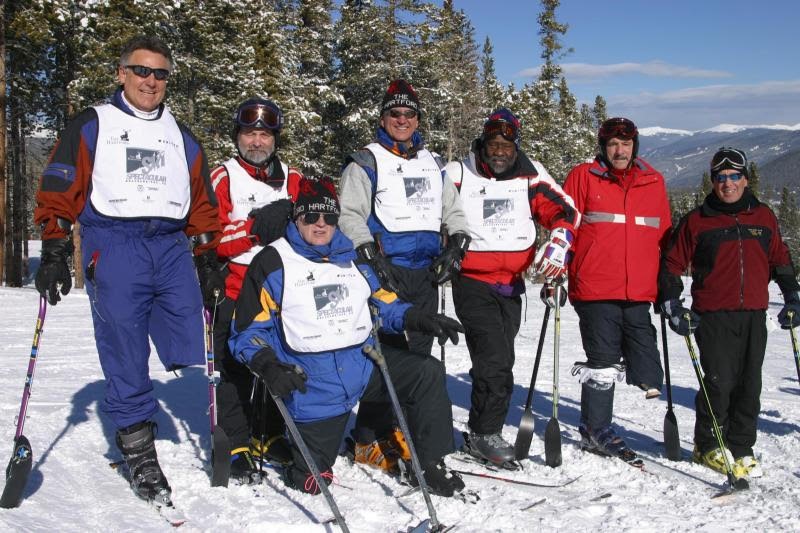
Pringle’s primary goal was to advocate for change and to ensure that Paralympians received equal benefits and services as Olympic athletes received, whether that constituted stipends, uniforms, training facilities, or insurance. “In my day, we were all amateurs, but now these kids or adults, they have to train all the time to be the best in the world,” Pringle said of the need for equal opportunity. “It takes a great deal of effort.”
Throughout his career, Pringle and those who worked for and with him never lost sight of their objective.
“We both felt like we were on a mission that we just could not move away from,” Hayes Rodriguez said. “We had our eye on the prize, which was that every ski area, or every park, or every swimming pool in the United States would be accepting of people with a disability and wouldn’t turn them away, or make them feel bad, or make it so expensive that they couldn’t participate.”