

By Dave Schuiling, PSIA-AASI Director of Education & Credentialing
Last month I wrote about training people skills with purpose. The idea was simple: great instructors don’t just develop technical and teaching skills, they intentionally work on how they relate to others. Communication, empathy, trust, and adaptability are skills that can be practiced and improved just like edging or timing.
Recently I had the opportunity to expand on that idea while presenting at the 6th SPE Balkan Ski Conference, in Kranjska Gora, Slovenia, sponsored in part by the International Association of Education in Science and Snowsports (IAESS). The theme of my presentation was Making People Skills Visible, and it led to an interesting reflection about the role these skills play in both snowsports education and the future of work.
We started the session with a simple question: What skills or behaviors did your favorite teacher or coach have?
When people answer that question, the words are remarkably consistent. Empathy. Patience. Humor. Belief in the student. Trust. Communication. Passion.
What’s interesting is that almost none of those responses describe technical ability. Instead, they describe how that teacher or coach made us feel and how they interacted with us as people.
Bringing People Skills to the Fore
For decades, professional snowsports education focused primarily on three core domains: technical performance, teaching skills, and professional knowledge of the sport. Those areas remain critically important. But many of the qualities that make an instructor truly great—how they connect with students, how they build trust, how they communicate and adapt—weren’t often front and center. They were recognized, but not always clearly defined. They were implicit. They were tacit.
The introduction of the Learning ConnectionSM framework helped change that. By identifying People Skills as a distinct domain alongside Teaching Skills and Technical Skills, we created a way to clearly describe the behaviors that define strong human interaction in a learning environment.
Behaviors such as:
- Building trust with students
- Communicating clearly and effectively
- Adapting to individual needs
- Demonstrating professionalism and self-management
- Creating an environment where people feel supported and capable.
Once these behaviors are articulated, something important happens. They become visible. And when something becomes visible, it can be practiced intentionally, discussed clearly, and assessed more consistently.
That visibility has also played an important role in aligning our credentialing system across disciplines. Using the Learning Connection as a foundation, PSIA-AASI has been able to define learning outcomes and assessment criteria that help create consistency in how instructor skills are developed and evaluated.
Thriving in a Rapidly Changing World
In doing this work, another interesting realization emerged. The skills we are talking about—communication, empathy, adaptability, collaboration—take time to develop. They require reflection, feedback, and experience. They require patience and persistence. Often, they involve struggle. In other words, they are not acquired overnight. And that creates a bit of a paradox.
We live in a world that is increasingly fast-paced and oriented toward immediate results. Technology moves quickly. Information is available instantaneously. AI can summarize, build, and generate answers in seconds.
Yet the skills that organizations are increasingly looking for such as communication, emotional intelligence, collaboration, and leadership take time to develop. They require practice, self-awareness, and what we might simply call grit.
Interestingly, these same competencies show up in many conversations about the future of work. Global workforce research consistently highlights human-centered capabilities as critical for the years ahead. Among the World Economic Forum’s emerging skills for 2030 and beyond are adaptability, empathy, emotional intelligence, collaboration, leadership, resilience, and curiosity (lifelong learning). Another framework, from the Inner Development Goals initiative, describes similar capacities in terms of being, thinking, relating, collaborating, and acting.
When you step back and look at these frameworks alongside the Learning Connection, the overlap is striking. The qualities that define great instructors are the same human skills that are increasingly valued across professions and industries.
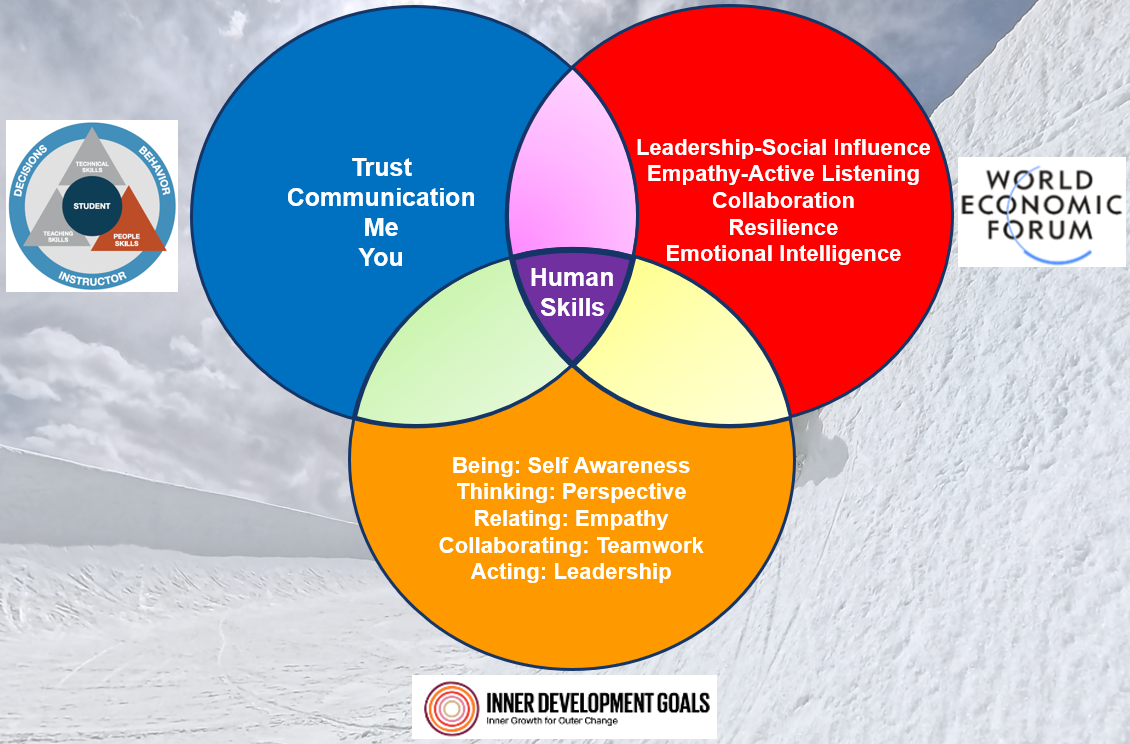
In other words, the relational competencies that help instructors create meaningful learning experiences on the mountain are also the kinds of capabilities that will help people thrive in a rapidly changing world. This doesn’t mean that snowsports instruction is about preparing people for corporate careers. But it does highlight something powerful about the role of instruction and snowsports education more broadly.
When we help instructors develop strong people skills, we are doing more than improving lesson experiences. We are cultivating human capabilities that are transferable far beyond the slopes. And as technology continues to advance, those capabilities may become even more important. The more advanced our tools become, the more valuable our human skills will be.