

By Christian Green, Executive Editor
This is the second story in recognition of the 2026 PSIA-AASI National Award recipients. Members were honored last week at National Academy, at Copper Mountain, Colorado, for their achievements as instructors, leaders, role models, and collaborators in the snowsports industry.
***
The term mecca and Northeast Ohio don’t typically go hand in hand when thinking about skiing. But when you have a mother and father who grew up in the mountains of Austria and Slovenia, respectively, chances are, it becomes an integral part of your upbringing.
Such was the case for 2026 Educational Excellence Award recipient Victor Gerdin, who cut his teeth skiing at Mont Chalet Ski Area, a diminutive ski hill with a 120-foot vertical drop in the Cleveland suburb of Chesterfield. After his parents emigrated from Europe in 1950, with just a box of clothes, a few dollars, and a pair of skis, his mom was determined to share her love of skiing with Victor and his brother.
“When she lived in Austria, my mom cross country skied to school every day in the wintertime,” Gerdin said. “My parents took my brother and me skiing for the first time in 1958, and by the early 1960s my mother became an instructor, and eventually the ski school director, at Mont Chalet.”
The passion for the sport that his mom in particular instilled in Gerdin led him to become a full-time instructor at Mont Chalet during his first two years of college, as he took winter quarters off to teach skiing. During this time, he dreamt about skiing out West, achieved his “Associate” (Level II) certification in PSIA-Central, and made that out-West aspiration come to fruition after his sophomore year in 1971.
He continued to attend college in the fall, spring, and summer quarters, but taught at Jackson Hole, Wyoming, during winter quarters until he earned his bachelor’s degree in engineering in 1975. Along the way, Gerdin reconsidered the type of engineer he wanted to be solely for the purpose of being outside more.
“I originally chose mechanical engineering as my major with the intent that I would eventually pursue employment with a ski lift manufacturer/installer,” Gerdin said. “But I soon realized that mechanical engineers worked and sat inside 99 percent of the 8 to 5 workday, so I adjusted my curriculum to be more civil engineering based, assuming that civils spent more time outside than inside.”
In the span of a couple years, Gerdin settled on a career path and region where he wanted to earn a living, adding that he “moved from the smallest ski area in the country to the tallest (most vertical) at that time.”
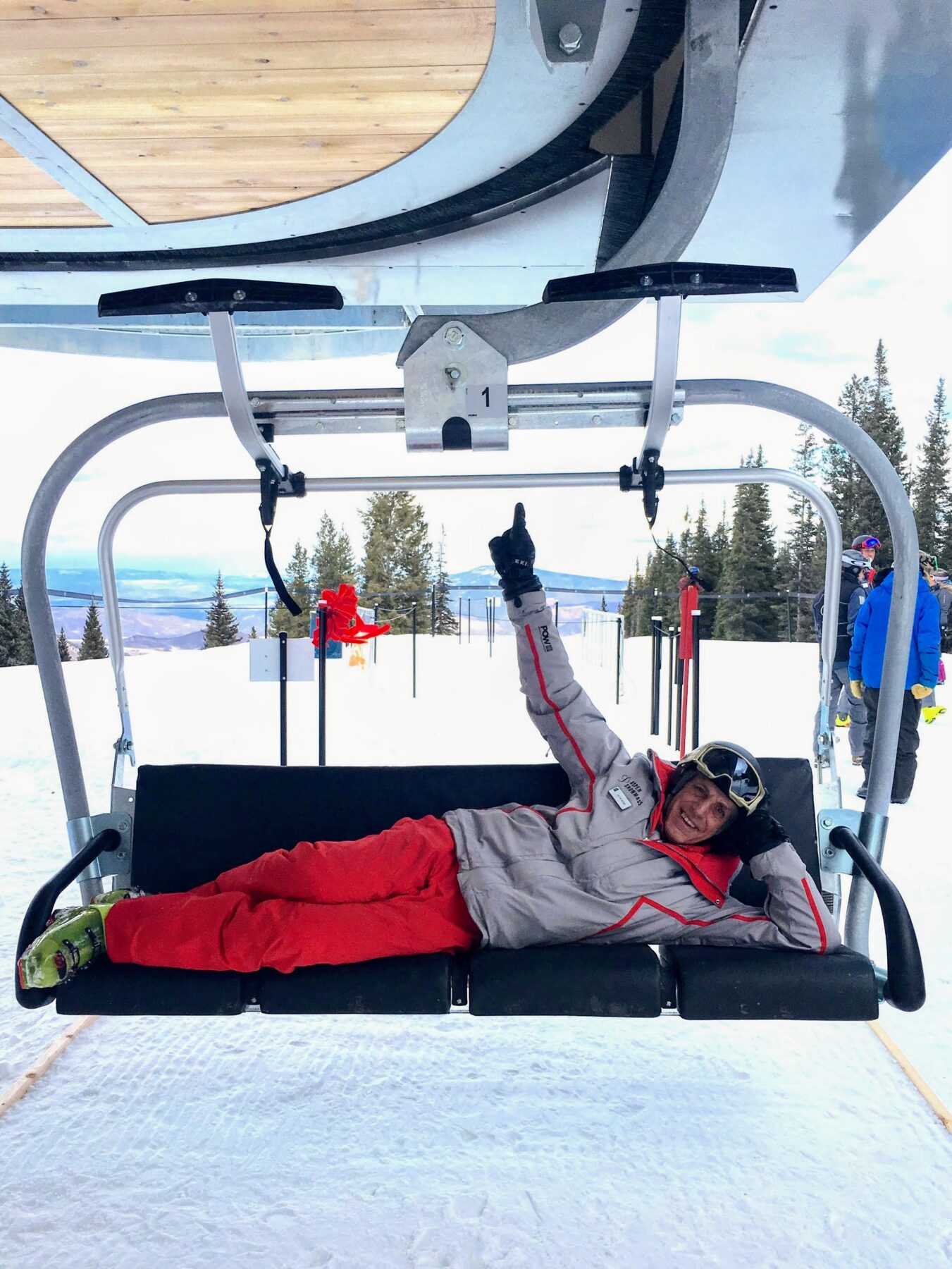
A New Beginning at Jackson Hole
Learning and teaching became Gerdin’s primary objectives at Jackson Hole, as he was fortunate to work under renowned instructor Bill Briggs. “Bill was the famous ski mountaineer who made the first ski descent from the summit of the Grand Teton (the summer before I arrived) and a brilliant ski coach, coaching anyone and everyone who wanted to become a skier,” Gerdin said of one of his first mentors. “Quite frankly, I still use some of the exact drills, exercises, and movements Bill taught me in the 1970s.”
Whether he was teaching children from Jackson Elementary every weekday afternoon at Snow King Mountain under the tutelage of Briggs or honing his skills on Jackson Hole’s challenging terrain, Gerdin immersed himself in his love of skiing, earning his “Full” (Level III) certification along the way. “Every moment I was not working, training, or sleeping, I was lapping every square foot of radical terrain accessed by the 4,130-foot vertical Jackson Hole Aerial Tram,” Gerdin said. “Therefore, I learned how to better guide people with tactics to maneuver through challenging situations, while coaching them to own solid technical skills.”
Another individual who had a profound influence on Gerdin during his time in Jackson was Josef “Pepi” Stiegler, an Olympic Gold Medal winner for Austria in the slalom at the 1964 Innsbruck Olympics and the ski school director at Jackson Hole. “Pepi was a driven leader who demanded excellence from his staff,” Gerdin recalled. “To this day, I still try to emulate his precise and disciplined skiing movements in my skiing, while also using them as metaphors for life.”
For example, Gerdin remembers nearly being able to keep up with Stiegler on the steeper part of Jackson Hole’s NASTAR dual giant slalom (GS) racecourse. However, as the terrain flattened out, Stiegler increased his lead at every gate, always winning by the longest margins. The message was more significant than what happened on the slopes that day: “In life, when conditions change, Pepi was teaching us to also adjust our plans (technique/tactics) to stay ahead of the competition,” Gerdin said.
In Jackson, Gerdin also worked as a surveyor for a local engineering firm and was then hired by JH Mountain Manager George Fleming as a surveyor/project lead for a new lift the resort planned to build. As Gerdin related, by the time he was 25, his career as an instructor/ski area planner was officially underway.
National Academy and D-Team Pursuit
In 1979, Gerdin attended National Academy, an impactful experience that changed his perception of skiing and teaching. He had the opportunity to be coached by PSIA Demonstration Team (now National Team) members Jens Husted, Mike Porter, Chris Ryman, and Jerry Warren. What stood out the most for Gerdin was the way “they directed individual attention to each participant’s mindset, body style, and goals with video analysis, which was direct and succinct.”
In 1980, Gerdin tried out for the PSIA Demonstration Team, but did not make the final cut. This prompted some soul-searching regarding how he skied. “That tryout very clearly revealed to me that my skiing required serious changes technically,” Gerdin said. “I also realized that in skiing seriously steep extreme terrain almost exclusively, I was learning a somewhat defensive technique intending to maintain “bombproof” skills in critical situations, but those defensive movement characteristics kept me from skiing fluid, smooth, and dynamic turns everywhere else.”
To address this, over the next four years Gerdin almost exclusively skied intermediate terrain (a hard thing to do in Jackson), which helped him obtain the dynamic skiing and technical skills that characterized the skiing of his D-Team idols. The work paid off for Gerdin as he became an examiner and was selected to the Demonstration Team in 1984, earning a spot on the team again in 1988 and then in 1996 (he did not try out in 1992).
However, once he was on the Demonstration Team, he soon learned there was no “magic wand” he would receive to make him, or anyone he taught, a better skier and teacher. “I realized that I had essentially been given the responsibility and resources to proceed in developing and formulating the future PSIA “magic wand” that would guide the growth of our association and its membership,” he said. “This would enable our members to ultimately offer life-changing experiences and sensations as skiers, to other skiers.”
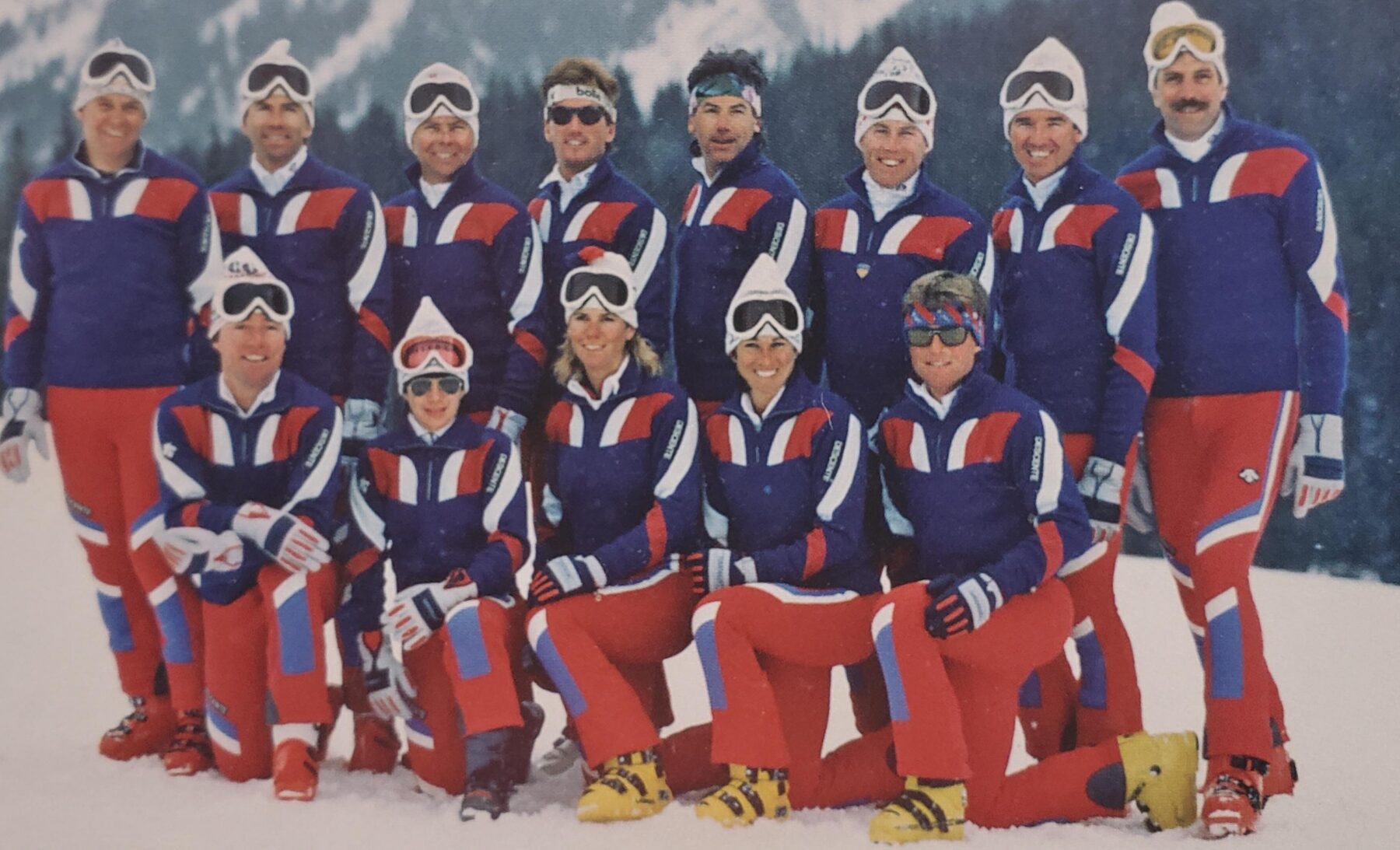
A New Position in Aspen
In 1987, Gerdin accepted a position in Aspen, where he was hired as ski school director at Buttermilk Mountain. It didn’t take him long to realize the difference between Jackson Hole and the Colorado resort. “A higher percentage of the terrain on the four Aspen areas was more docile than Jackson’s,” he said. “It was easier to teach students to let go and move with gravity and ski in a taller more ‘elegant’ posture, instead of trying to control gravity in a crouched stance skiers typically use on steeper slopes because it ‘feels’ safer.”
It was in Aspen where another mentor would play a huge role in Gerdin’s career and life: fellow 2026 Educational Excellence Award recipient Wharton “Weems” Westfeldt. The two quickly became acquainted when Gerdin arrived at Buttermilk Mountain, and then they developed a strong friendship at Snowmass, where Gerdin was named ski school director and Westfeldt assistant director in 1989.
When the two were hired, Aspen Skiing Company’s senior management did not support PSIA, which meant they downplayed Gerdin’s and Westfeldt’s roles, particularly the former’s as a member of the Demonstration Team. But by the mid-1990s, ASC was under new management, and Gerdin and Westfeldt led the way in helping Snowmass Ski School evolve into the Ski and Snowboard Schools of Aspen (SSSA).
“Weems was a great assistant who always kept me focused,” Gerdin said. “In a way, he was the visionary, and it was me who made the ideas he had real, meaning on-time and under-budget.”
Gerdin added that Westfeldt mentored many instructors at Aspen and played a significant role in making Aspen Academy and SSSA renowned. “I always kidded him that I stole more ideas from him than he ever remembered,” Gerdin said, emphasizing that SSSA will forever use the concepts from Westfeldt’s book, Brilliant Skiing, Every Day, to help instructors become better teachers.
During this time, Gerdin also had the good fortune to collaborate with another industry leader, Buttermilk Mountain Ski School Director Jerry Berg, who also received the 2026 Educational Excellence Award. According to Gerdin, “Bergie” “helped drive Buttermilk Mountain’s renowned kids’ program to legendary status, with tales of Colonel Forten and Max the Moose in the original Fort Frog, which Berg and Gerdin built from ‘boneyard ticket kiosks’ and lift shacks covered with free slab wood from a local sawmill.”
After the formation of SSSA, Berg ultimately set the initial Aspen Academy concept in motion, which eventually became the framework for SSSA’s impeccable training principles. To this day, it remains a key element to SSSA’s success in the industry.
Collectively, Westfeldt, Berg, and Gerdin learned an important principle to impart on their instructor staff – that it’s critical to understand personal strengths, then determine how to capitalize on those strengths to encourage outside-the-box thinking on a daily basis.
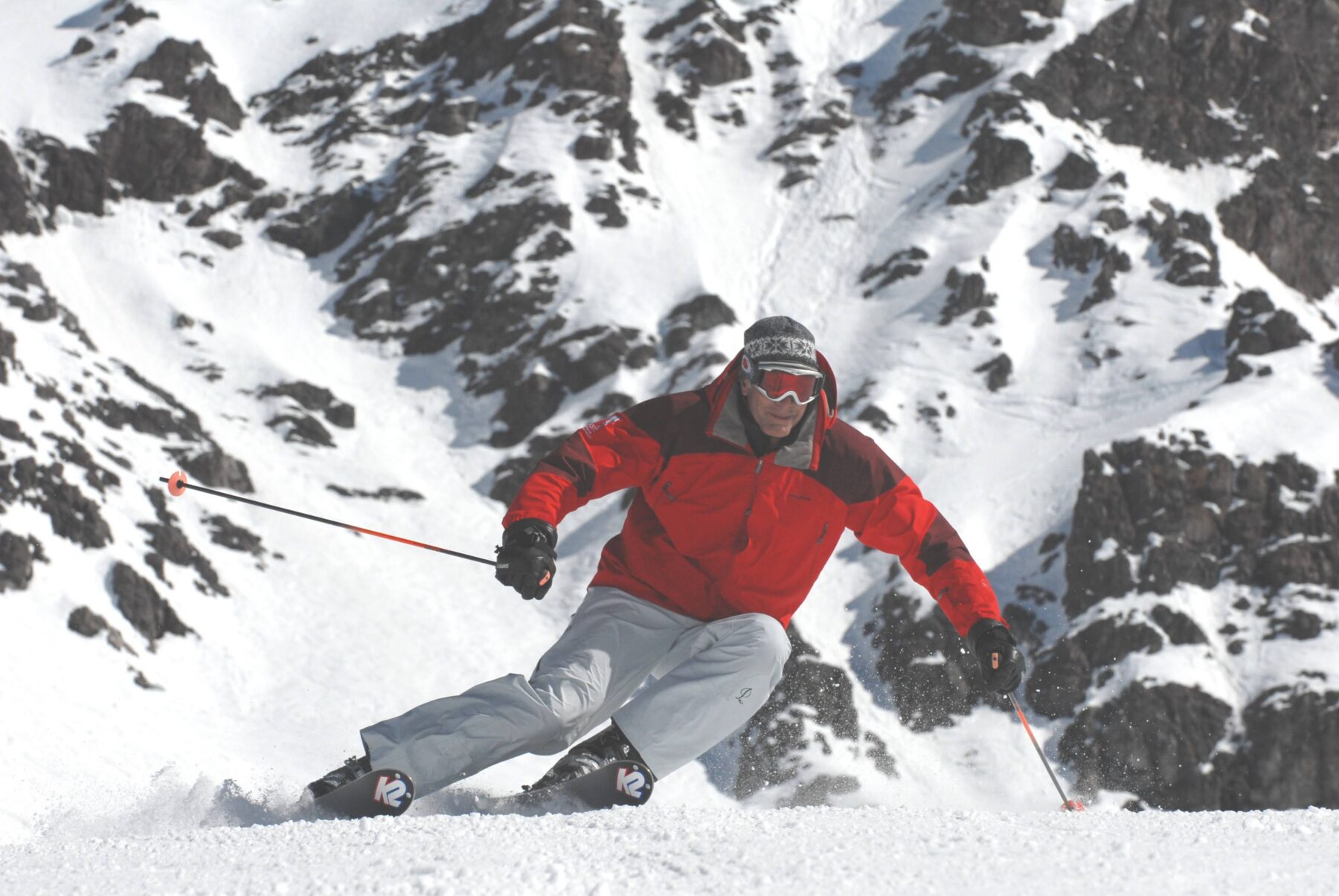
Education Steering Committee Chairman
With ASC’s support (this time), Gerdin earned a spot on the PSIA Alpine Team in 1996 and during this term was asked to serve as PSIA Education Steering Committee chairman. Also, during this time, the National Team developed the “Centerline” to complement the foundation of PSIA’s original Skills Concept of Turning, Edging, and Pressure Control.
“The Centerline was simply a way to describe a movement pattern that remained consistent, through all levels of intensity – from wedge turn to dynamic parallel – which added more versatility to the original Skills Concept,” Gerdin said.
This movement pattern, which essentially involves turning both legs continuously through the turn, easily allowed instructors to visualize/feel how lower-level maneuvers connect to upper-level ones. Then, to address the skills and movement patterns needed to adapt to varied snow conditions (powder, crud, bumps, ice), a trainer could visually use the Centerline model and laterally shift from the center as a way to plot the varied movement needs to control those situations.
As Gerdin expressed, the Centerline concepts became the framework for the 2002 Alpine Technical Manual (authored primarily by Megan Harvey and the Alpine Team) to address the industry-changing revolution of shaped skis and their “direct to parallel” possibilities for skiers of this era and beyond. He added that the “Stepping Stones model within this manual (brought to life by Kim Seevers) helped frame a process in which instructors could fast-track or slow down a student’s progress to parallel skiing, which gave instructors license to help students become skiers in some very fun, playful, and personal ways.”
At this time, PSIA Education Director Linda Crockett worked with the Education Steering Committee to address an overall teaching methodology, across all disciplines. The 2001 Core Concepts for Snowsports Instructors, which Crockett and Steering Committee member Maggie Loring collaborated on, became the go-to manual to train any discipline toward great teaching skills.
Mountain Planning and Return to Instructing
When Gerdin returned to instructing in 1997, he was approached by ASC’s Vice President of Planning and Development Bill Kane to consider becoming mountain planner for Aspen Snowmass. “Kane knew of some ski trail and lift installation projects I completed for the Jackson Hole Ski Corporation,” Gerdin said. “I countered that I was a skier at heart and would be a very grumpy planner if I was in the office five days a week.”
Fortunately, Gerdin was able to convince Kane and Chief Operating Officer Mike Kaplan that he could teach and plan in the winter as long as he was able to prioritize what was needed to complete projects. “I had a blast working with Mike implementing many mountain improvements, especially the Elk Camp Meadows Beginner Park, mostly while looking at the mountain through the eyes of the low-intermediate/intermediate skier, by utilizing the knowledge I gained teaching them to be better lifelong skiers,” he said.
Gerdin continued that strong relationship with Kane’s successor, David Corbin, through his retirement from planning in 2022. “He showed me the value of precise planning and to never accept mediocrity,” Gerdin said. “It was amazing to watch David dedicate himself to his company and to the projects he nurtured as we worked together.”
Gerdin underscored that he’s been given — and capitalized — on many opportunities to share what he’s learned in life, on and off the mountain. He’s especially flattered when a fellow instructor lets him know that a concept he taught in a clinic changed their lives or that an article he wrote resonated with them.
To that end, Gerdin has focused on being authentic and ensuring that those he’s teaching understand what he’s saying and why he’s saying it. “Every lesson is different for every person who comes to me with a different goal, a different set of technical restrictions, and what they want to do emotionally,” he said. “With this in mind, I’ll change what I do to adapt to those people according to their needs.”
Throughout his career, he kept a common instructor mantra top of mind, which he admits having also probably stolen from someone like Westfeldt or SSSA trainer David “Squatty” Schuler: “Your students won’t care how much you know . . . until they know how much you care.” And showing how much he cares about those he taught and worked with has endured from Mont Chalet to Jackson Hole to Aspen and everywhere in between.
***
In addition to Gerdin, three former PSIA-AASI members were honored with this year’s Educational Excellence Award posthumously:
- Weems Westfeldt, long-time PSIA Rocky Mountain Region examiner, PSIA Demonstration Team member, and author of Brilliant Skiing, Every Day.
- Jerry Berg, PSIA trainer, Rocky Mountain Region examiner, and PSIA alpine committee chair, as well as PSIA Demonstration Team member.
- Jean Mayer, member of the French junior ski team and national champion, member of the 10th Mountain Division, and technical director of the Ernie Blake Snowsports School at Taos Ski Valley.