

By Angelo Ross, PSIA-AASI Education Development Manager
Why do some students improve quickly while others plateau despite equal effort? The answer may lie not in how much they practice, but in the marriage of certain motivational and attentional factors: high expectations, student autonomy, and where learners’ attention is focused.
Research in motor learning demonstrates that performers who focus their attention external to the body outperform those who concentrate on their body mechanics. This distinction—external focus versus internal focus—reveals a deep truth about learning motor skills: skills develop faster when thinking is shifted away from moving body parts and instead to accomplishing a particular task. In their 2016 paper Optimizing performance through intrinsic motivation and attention for learning: The OPTIMAL theory of motor learning, Gabriele Wulf and Rebecca Lewthwaite provide evidence for this and explain how, when coupled with motivational factors of high expectations and student autonomy, targeting mental focus external to the body increases the efficacy of learning motor skills.
In their paper, Wulf and Lewthwaite discuss enhanced expectancies, autonomy support, and external focus and how they “contribute to performance and learning by strengthening the coupling of goals to actions.” Enhanced expectancies (EE) are beliefs that students will be successful, which creates confidence and sets the stage for effective action. Autonomy support (AS) involves creating a learning environment in which students have meaningful control over aspects of their learning, which provides students with agency and fosters motivation. External focus (EF) is directing attention toward desired outcomes of movements rather than the movements themselves, which reduces conscious self-monitoring [Ever overthink your own performance?] and frees up mental space, which, in the authors’ words, “promotes efficient neuromuscular coordination and automaticity” in performance.
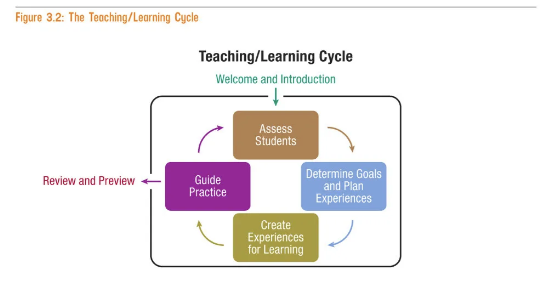
How might we integrate OPTIMAL into the PSIA-AASI Teaching/Learning Cycle to enhance the on-snow learning environments we collaborate with our students to create? [Log in to your member account, access Professional Development → Digital Manuals, All Disciplines to access the PSIA-AASI Teaching Snowsports Manual, Chapters 2 and 3 for more information on learning and teaching.]
ENHANCED EXPECTANCIES
Each of us—students and teachers—brings a virtual database of life experiences to the learning environment that consciously and unconsciously mold that time together. Biases shape what we notice; emotional baggage shapes how we react; expectancies shape what we anticipate. From Wulf and Lewthwaite, “Expectations carry personal histories of experiences forward in time into new contexts to allow preparation for future events.”
Few people, including teachers, enter a class completely free of stress, which runs the gamut from mild nervousness or apprehension to debilitation. OPTIMAL Theory demonstrates that we can increase motivation and expedite skill development through enhanced expectanices—foward-directed beliefs about student success that raise confidence and self-efficacy through positive feedback, recognizing successes, and self-modeling (showing a student their own successful performance on video, when appropriate).
Beyond feedback and self-modeling, enhanced expectancies can be cultivated intentionally within the learning environment. One powerful strategy is the deliberate creation of early success. When tasks are structured so that learners experience authentic, achievable mastery at the outset, confidence becomes evidence-based rather than aspirational. A simple way to implement this is by beginning a class with something you know students can achieve. These early wins divert anticipation from “I hope I can” to “I have.”
This principle aligns closely with Carol Dweck’s work on Growth Mindset, which frames ability as developable through effort, strategy, and feedback. When learners believe skill is malleable (as opposed to fixed), challenge becomes an opportunity rather than a threat. Similarly, Anne Donnellan’s concept of presumed competence reminds educators that from an ethical standpoint expectations must begin high. The “least dangerous assumption” is to assume students are capable.
Together, early structured success, growth-oriented messaging, and presumed competence create a learning environment in which forward-directed beliefs about success are credible and sustainable. In such environments, expectancy is not empty encouragement; it is a carefully engineered condition that prepares learners neurologically and psychologically for effective action.
AUTONOMY SUPPORT
Students bring a fundamental psychological need into the learning environment: the desire for agency. Autonomy impacts motivation as it influences how invested we feel, how much effort we expend, and how resilient we are when challenged. Control shapes motivation; choice shapes engagement; voice shapes commitment. When students have meaningful influence over aspects of their learning, their connection to the task changes. As OPTIMAL Theory demonstrates, supporting autonomy strengthens motivation and prepares the learner for effective action.
Support of autonomy is cultivated when teachers shift from pontificators to facilitators, designing environments in which students participate meaningfully in their own learning. Student-centered goal setting invites learners to articulate what they are working toward, while self-controlled practice—allowing choice in task order, terrain, or repetition—builds ownership and engagement.
Autonomy also includes asking learners when they would like instruction and feedback and in what form: verbal cues, demonstrations, drawings, or personal video when appropriate. A simple question such as, “Are you satisfied with that attempt?” redirects evaluation back to the student and strengthens reflective capacity. Providing choice does not diminish rigor; it sharpens commitment.
Scaled feedback further reinforces agency. Instead of binary judgments, calibrated responses (“On a scale of 1–10, how helpful was the Tall & Small practice for when we were off-piste?”) encourage metacognition (thinking about your own thinking) and self-assessment. In each case, the teacher retains structure while transferring appropriate control to learners. When students experience genuine choice and voice within clear parameters, motivation increases, defensiveness decreases, and the learning environment becomes collaborative rather than directive.
EXTERNAL FOCUS
External focus may be the most difficult principle for us to implement as instructors, as our tendency within PSIA-AASI is to coach primarily toward body movements and mechanics. Language shapes attention; attention shapes coordination; coordination shapes performance. OPTIMAL Theory demonstrates that where students direct their attention matters more than the anatomical detail of the cue. As Wulf and Lewthwaite argue, directing attention toward the intended effects of movement strengthens the coupling between goals and actions. Try replacing anatomical landmarks (lift your pinky toe; close your ankles; tilt your shin) with external landmarks (align your helmet over the outside boot; make the tail of the board travel the path the nose creates; press the scales into the snow).
External focus requires intentional discipline in an association whose language naturally gravitates toward body mechanics. We are accustomed to cueing toes, ankles, knees, hips, shoulders, and hands; yet research consistently shows that attention directed external to the body—toward the effect of the movement—produces stronger learning than internal, body-part cues. Further, OPTIMAL Theory demonstrates that distal external cues (farther from the body) are more effective than proximal external cues (closer to the body). Translated to the job of snowsports instruction, this suggests focusing attention to turn size and shape (Look down the hill and visualize letter Cs half as wide as the slope, then trace those Cs with your board as you ride) may yield better results than directing attention to the equipment (Keep your belt buckle aligned over the outside boot to direct more pressure to the outside ski.)
This shift is equally valuable in movement analysis. When we fixate on superficial anatomical differences among students, we risk descending into a rabbit hole of ineffective cues. A functional understanding of equipment design—boots, skis or boards, poles (when applicable)—keeps our attention anchored to interaction with the tool and the snow or the boot and the ski/board.
INTEGRATING OPTIMAL THEORY INTO OUR TEACHING
Skill development is not merely a function of repetition; it is a function of conditions. When high expectations are paired with authentic early success, learners begin from a position of belief rather than doubt. When autonomy is supported through meaningful choice, reflective questioning, and calibrated feedback, students invest more deeply in their practice. When attention is directed outward—toward the effects of movement rather than the mechanics of body parts—coordination becomes more efficient and performance more resilient. Enhanced expectancies, autonomy support, and external focus are not separate techniques to be layered onto a lesson; they are ambient environmental components that shape how learning unfolds. By integrating OPTIMAL Theory into the PSIA-AASI Teaching/Learning Cycle, we move from coaching movements to engineering learning conditions—conditions under which students do not merely practice more, but improve more. These principles apply to our own practice and development as well as our students’. As Wulf and Lewthwaite state, “While it may seem deceptively simple and almost automatic, expert performers find ways to will efficient and sometimes spectacular movements into being.”