

By Dave Schuiling, PSIA-AASI Director of Education and Credentialing
PSIA-AASI defines four People Skills fundamentals:
- Develop relationships based on trust.
- Engage in meaningful, two-way communication.
- Identify, understand, and manage your emotions and actions.
- Recognize and influence the behaviors, motivations, and emotions of others.
Sometimes we casually refer to them as Trust, Communication, Me, and You. That’s not a new framework or model. It’s just a simple way to remember what already exists.
What matters isn’t the shorthand. What matters is how intentionally we train and apply these skills, because people skills are not personality traits. They are behaviors that can be learned and measured. In our snowsports education world, as in any occupation focused on human interactions, they are professional skills. And they can be practiced.
Trust: The Foundation of Learning
If a student doesn’t feel safe, learning slows down and could completely stop.
Research on psychological safety from Harvard Business School professor Amy Edmondson shows that people perform and learn better when they believe they won’t be embarrassed or punished for mistakes. On snow, that translates directly:
- Will this student try something new?
- Will they admit confusion?
- Will they risk falling?
Trust shows up in behavior. Most of the time trust can be built as the culmination of the other three people skills fundamentals. How we communicate, how we show up personally, and how we forge relationships with others.
Instructors can practice building trust intentionally with the following in mind:
- Use names early and often.
- Acknowledge effort before correction.
- Normalize struggle (“This is such a common challenge.”).
- Maintain a steady tone when things go sideways.
After a lesson, instructors can ask: “Did my students take risks today?” “Did they push boundaries and work with me through the learning struggle?”
If the answer is yes, you likely built trust.
Communication: Dialogue, Not Monologue
Learning is not information transfer. It’s construction from the ground up. Psychologist Lev Vygotsky emphasized that knowledge is built socially through interaction. In other words, students learn better when they are part of the conversation.
In practical terms:
- Ask before telling.
- Paraphrase before advising.
- Confirm understanding before moving on.
A simple discipline that’s so easy to say, but so much harder to apply, is to speak less than you think you need to.
Replace: “Here’s what you need to do.”
With: “What feedback were you getting from your ski(s)/board?” “What do you think is happening there?”
When students articulate their own experience, retention increases and ownership grows.
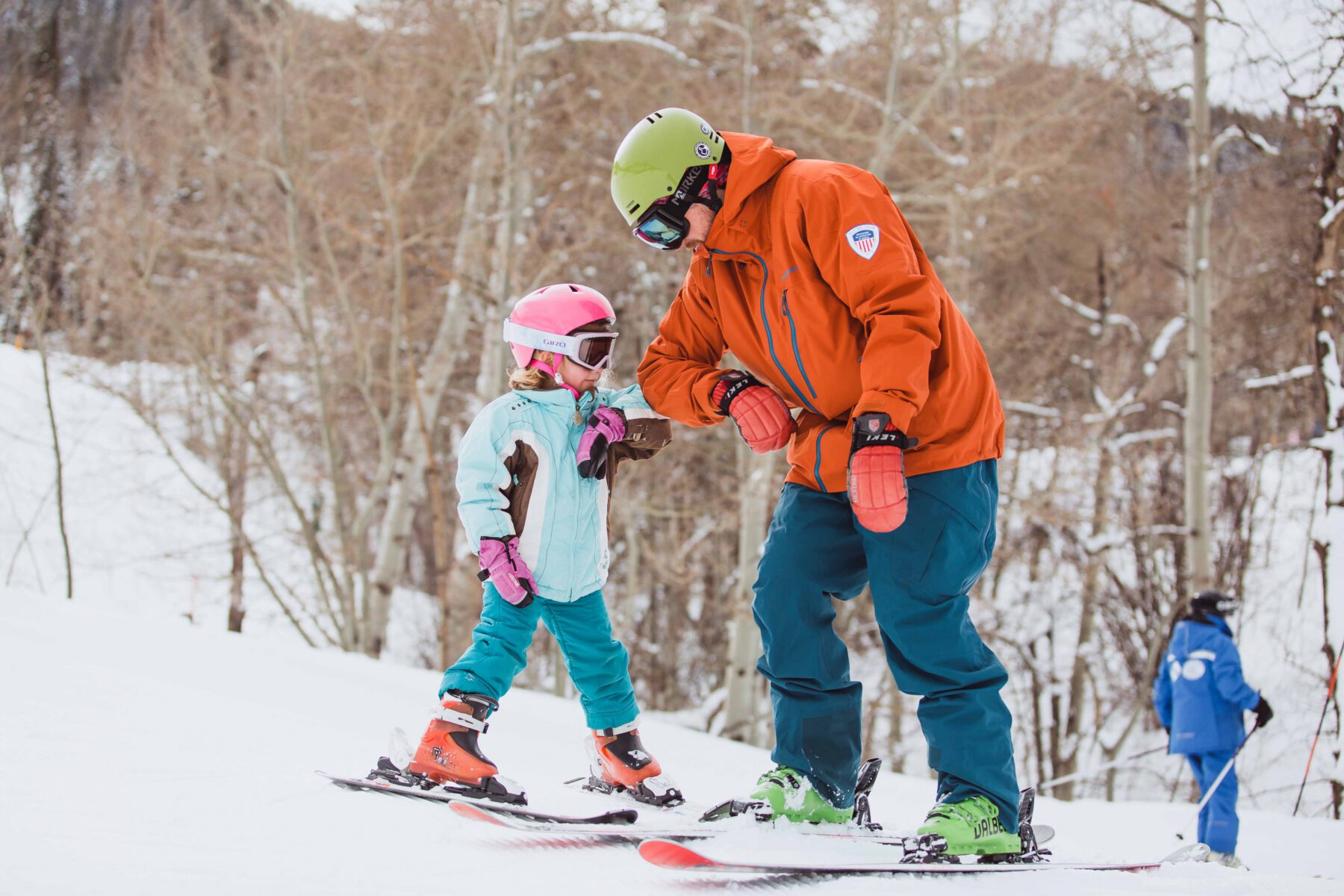
Managing “Me”: Emotional Regulation on Snow
This may be the most overlooked professional skill we have. Psychologist and author Daniel Goleman describes self-awareness and self-regulation as foundational leadership competencies. Instructors are leaders. And our emotional state sets the climate of the lesson.
Students read us constantly. If we’re rushed, they feel rushed. If we’re frustrated, they tighten up. If we’re calm, they settle.
Leadership and executive coach Todd Musselman is known for saying: “No one ever got a feeling wrong.” That line has stuck with me. Feelings aren’t mistakes. They’re data. If a student says, “This feels terrifying,” correcting the logic (“You’re safe”) might be technically true, but it skips over the emotional reality. Validation doesn’t mean agreement. It means acknowledgment.
Instead of saying: “It’s not that steep.”
Try: “From here, it does look steep. I can see why that feels intimidating.”
That moment of validation regulates the nervous system, builds connection, and it increases coachability.
As instructors, we can practice managing “Me” by:
- Taking one breath before responding under stress.
- Lowering our voice intentionally in tense moments.
- Reflecting after lessons: Where did my emotions influence my decisions?
Self-awareness improves with repetition.
Understanding “You”: Motivation and Attunement
Once we manage ourselves, we can better tune into others. Self-Determination Theory, developed by Psychologists Edward Deci and Richard Ryan, suggests that people are motivated the most when three needs are supported:
- Autonomy (choice)
- Competence (progress)
- Relatedness (connection)
You see this every day on snow. Students engage more when:
- They have a choice in direction.
- They see clear progress.
- They feel understood.
Seeking to understand is not automatic. It’s practiced. In training clinics, try this:
- One instructor describes and role-plays a frustrated or fearful student whom they’ve recently had in a lesson.
- The other instructor may only ask questions and reflect emotions for two minutes.
- No solutions allowed.
It’s harder than it sounds. But the goal isn’t to fix. It’s to understand. When students feel understood, they become more open to coaching.
Making It Observable
If people skills matter, we should be able to see them. During peer observations, training clinics, or self-reflection, we can simply align feedback to the existing fundamentals:
Trust
- Did the instructor create psychological safety?
- Did students appear willing to take risks?
Communication
- Was there balanced dialogue?
- Did the instructor check for understanding?
Managing Self
- Did the instructor regulate tone and pace?
- Were emotions acknowledged before redirection?
Understanding Others
- Did the instructor adjust based on student response?
- Was motivation considered?
There are no new models required; just sharper awareness.
Being aware of the Learning ConnectionSM helps us continually make decisions and behave in a way that intersects technical, teaching, and people skills. Technical skills lead to understanding and awareness of how board performance and body movements create outcomes on snow. Teaching skills create the connection of students and instructors to the learning environment to build new skills and refine old ones for better function and efficiency. People skills connect the student and instructor, opening a myriad of possibilities for better learning.
The most effective instructors in the locker room aren’t just technically accurate. They are intentional about connection. They notice emotions. They validate. They adapt and they reflect. And they practice these skills the same way they practice movement skills – with repetition, feedback, and curiosity. Connection isn’t accidental. It’s trained.
References
Deci, E.L., & R.M. Ryan (2000). “The ‘what’ and ‘why’ of goal pursuits: Human needs and the self-determination of behavior. Psychological Inquiry, 11(4), 227–268.
Edmondson, A.C. (2018). The fearless organization: Creating psychological safety in the workplace for learning, innovation, and growth. Wiley.
Goleman, D. (1995). Emotional intelligence: Why it can matter more than IQ. Bantam Books.
Musselman, T. For more information, visit https://toddmusselman.net/
Vygotsky, L.S. (1978). Mind in society: The development of higher psychological processes. Harvard University Press.