

By Christian Green
Sometimes love needs an extra nudge. It may be experienced intermittently, but it’s easy to recognize when it turns into something more. Such was the case for Sipapu Ski School Director Edward Herrera, a Level I alpine and snowboard instructor, with a Children’s Specialist 1 certificate, who found his passion for snowsports in the mid-1990s at the small Taos County, New Mexico, resort he works for today.
“When I was in elementary school, my family would visit my great-grandmother in Cheyenne, Wyoming, and my grandmother would take me to different ski resorts throughout the Rockies during those trips, and I took a few lessons here and there,” Herrera said. However, he says his love of snowsports wasn’t ignited until his dad, a part-time ski instructor, introduced him to Sipapu when Herrera was in fourth grade.
That year, he truly began to learn how to ski, under the tutelage of Lloyd Bolander, who, along with his wife, Olive, founded Sipapu in 1952, the first lift-served ski area in New Mexico. As pioneers and industry leaders, the couple were inducted into the New Mexico Ski Hall of Fame in 2004. What’s more, their daughter, Sue Leslie, the longtime ski school director at Sipapu, also began teaching Herrera in the resort’s Little Noodle Program.
In fifth grade, Herrera started helping instructors with lessons, including those taught by his dad. Although he focused on the little things at first, the exposure he received left a lasting impression.
“If a student’s ski popped off, I’d help get them sideways to the hill and get their downhill ski on first and then their uphill,” he said of one of his tasks. But he was also “able to observe all the progressions [during a lesson], which was really interesting and fun.”
Herrera never looked back, teaching skiing in some capacity through high school, while also learning to snowboard in middle school.
Vision Comes into Focus
When he got to college, Herrera continued to teach skiing on weekends and holidays, despite taking 18 credits each semester and playing football. During his sophomore year, Leslie, who had become his supervisor, pulled him aside to inform him that he’d outgrown Sipapu. She contended that if he wanted to advance in his career, he would need to spend some time working at a larger ski area.
“So, I went to the PSIA training groups up in Taos and Angel Fire,” Herrera said. He then earned his Alpine Level I certification and got involved with snow sliding devices, such as skiboards, ski bikes, and ski trikes, while also becoming New Mexico’s first pro snowboard bike rider. Ultimately, this helped him earn the role of supervisor of those sports at Sipapu.
It was also at Angel Fire where he met current Rocky Mountain Region Board Director Robin May (also a member of the New Mexico Ski Hall of Fame), whom he would go on to spend 13 seasons working for, starting in 2009.
While at Angel Fire, Herrera did a lot of coaching, including serving as the head snowboarding freestyle coach and intermediate advanced ski coach. In spring 2021, he returned to Sipapu, taking over as ski school director. “They’d been without a director [since Leslie retired in 2015], and the school program was struggling without that leadership,” he said.
Reviving Sipapu’s School Program
When he took over at Sipapu, one of Herrera’s immediate goals was to address the floundering school program. So, he turned to the network he developed over the years. During college, he worked for Upward Bound, and then, after leaving college, he began coaching high school football and track. Both avenues helped provide access to area schools. In addition, before every snowsports season, he started visiting schools in northern and central New Mexico to promote Sipapu’s school program.
“I knew that if I networked the right way with enough schools, I’d be able to bring in groups,” Herrera said. “The recruitment process for the school program is also a recruitment process for the resort and for my ski school.”
Herrera visited schools in Penasco, Las Vegas (where he recruits the most), Santa Fe, Española, Taos, Mora, Villanueva, Pecos, Albuquerque, and Socorro, to name a few. He noted that there are even schools in Las Cruces, in southern New Mexico, that have shown interest in Sipapu’s school program. Before long, the program took off – the resort now has around 40 school groups (the largest school program in the state), from grades 3 through 12, as well as three more groups from local colleges.
The newfound popularity has often led to multiple schools being booked on the same day. Therefore, it’s become a priority to ensure that there are always enough instructors on the hill, especially when the general public also has to be accounted for. And Herrera’s done exactly that – increasing the number of instructors from 5, when he took over as ski school director in 2021, to 44 last year.
Given the demand, he’s had to establish some parameters with the school program. “My minimum requirement is that for a school to have a ski club, they have to have at least 15 participants,” he said, adding that he’ll sometimes combine schools if there aren’t enough participants.
The school program also leans heavily on the New Mexico Youth Conservation Foundation, which provides grant money to schools to cover transportation, lessons, rentals, and lift tickets.
“We try to give local kids an opportunity to participate in snowsports, even if their families aren’t financially able to do it or able to provide transportation,” Herrera said. “Some of these kids’ parents may be abusing drugs or alcohol and their grandparents are raising them. They wouldn’t be able to enjoy snowsports or even get outside if it wasn’t for the program.”
Herrera is proud to be able to offer affordable lessons, citing Sipapu’s ownership group, Mountain Capital Partners, for making that possible. It’s a big part of MCP’s purpose, which is to “Give People the Freedom to Ski.” At Sipapu, kids can get an hour and a half lesson, an all-day lift ticket, and an all-day rental for well under standard industry rates. “We’re able to give back to people and make it affordable for families . . . even if they don’t have a lot of money,” he said.
Retention and the Value of Certification
Many of Herrera’s instructors are in high school or college and work part time, so retention can be challenging. This is particularly true if it’s their first job teaching on weekends, holiday break, and spring break. “I tell my young instructors that you have to love it; if you don’t love it, it’s hard to continue to work in an industry that’s seasonal,” he said.
Another pain point is educating instructors on the value of certification. “The biggest piece of advice I could give a new instructor is to attend clinics and exams,” Herrera said. “Even if it’s online courses, I tell all my new instructors there’s so much material out there nowadays compared to when I first started.”
He also noted that it can be difficult to convince young instructors to renew their memberships and recertify when their certifications lapse. That’s why it’s important for him to let them know about scholarship opportunities that can help offset the cost of getting certified.
Through it all, he acknowledges how rewarding it is to see some of his instructors go on to make a career as a snow pro. “It’s pretty awesome knowing that I have people spreading their wings and bettering themselves in the ski and snowboard industry,” he said. “I take pride in helping to give young people an opportunity, much like I had.”
Balancing Competition, Duties at Sipapu
Beyond his passion for snowsports instruction, Herrera is a competitive freeskier. A three-time United States of America Snowboard and Freeski Association (USASA) all-around national champion, he won titles in 2022, 2023, and 2025, and brought home 18 medals since he started competing in 2018.
He focuses on three events – slopestyle, ski cross, and halfpipe – but he’s also competed in snowboard giant slalom and slalom. During this year’s national championships, at Colorado’s Copper Mountain, he posted personal-best scores in halfpipe and recorded the highest free ski score in all divisions.
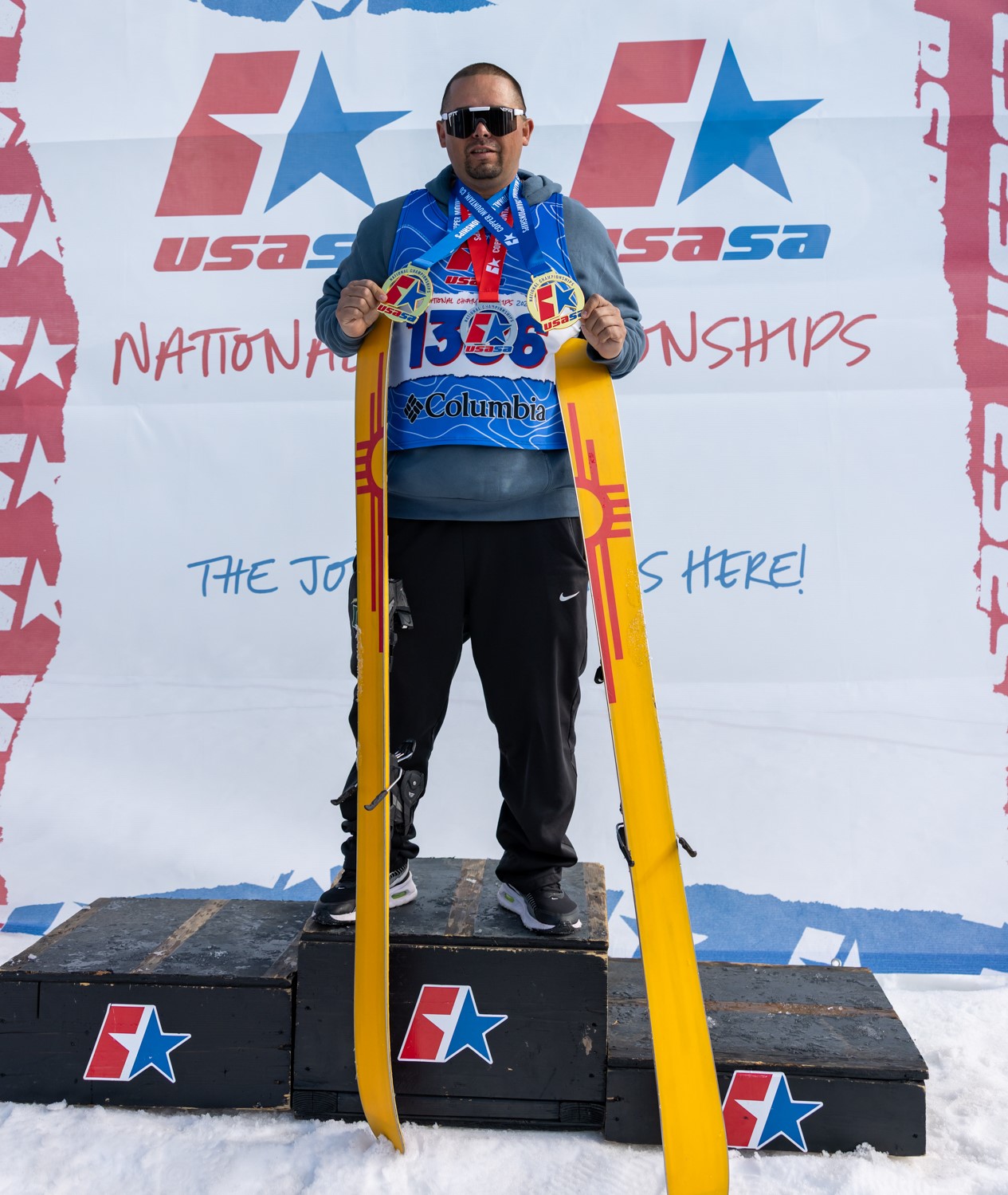
with his New Mexico Zia symbol Just Point It skis. PC: USASA
Typically, there are three or four regional USASA events each season, which take Herrera away from his duties at Sipapu on Fridays, Saturdays, and Sundays. “It can be challenging if I don’t have the staff that can teach upper-level freestyle classes, moguls, or tree runs,” he said. “Sometimes I’ll work five to six days straight, have a competition, and not have a day off, and then be back teaching and directing.”
With his demanding schedule, it would be difficult for Herrera to compete internationally or even train and qualify for the Winter X Games. That said, he’s quick to point out that his family and the Sipapu community come first. “It would cost me a lot to pull myself away from my real life and my career,” he conveyed, noting that his 12-year-old daughter and being a role model for local kids take precedence.
Serving as a positive influence drives Herrera, and he’s a testament to how snowsports can help shape a person’s life. He hopes that the kids he teaches at Sipapu can have a similar experience. “I want to see the industry keep growing because kids need to have outdoor opportunities in the winter, not be stuck sitting at home,” he conveyed.
***
Herrera would like to thank his assistant, Jennifer Gonzalez, for her hard work and dedication while he competes in USASA events and Sipapu General Manager John Paul Bradley for giving him the opportunity to become ski school director at Sipapu.